World Health Organization water AI could redefine early contamination detection — shifting safety systems from reactive testing to predictive protection.
World Health Organization Water AI is not a branded program. It describes a structural shift in how global health systems detect risk.
Public health has a timing problem. By the time hospitals report a spike, transmission has often already spread. However, outbreaks do not begin in clinics. They begin in communities. Increasingly, the earliest signal moves through wastewater.
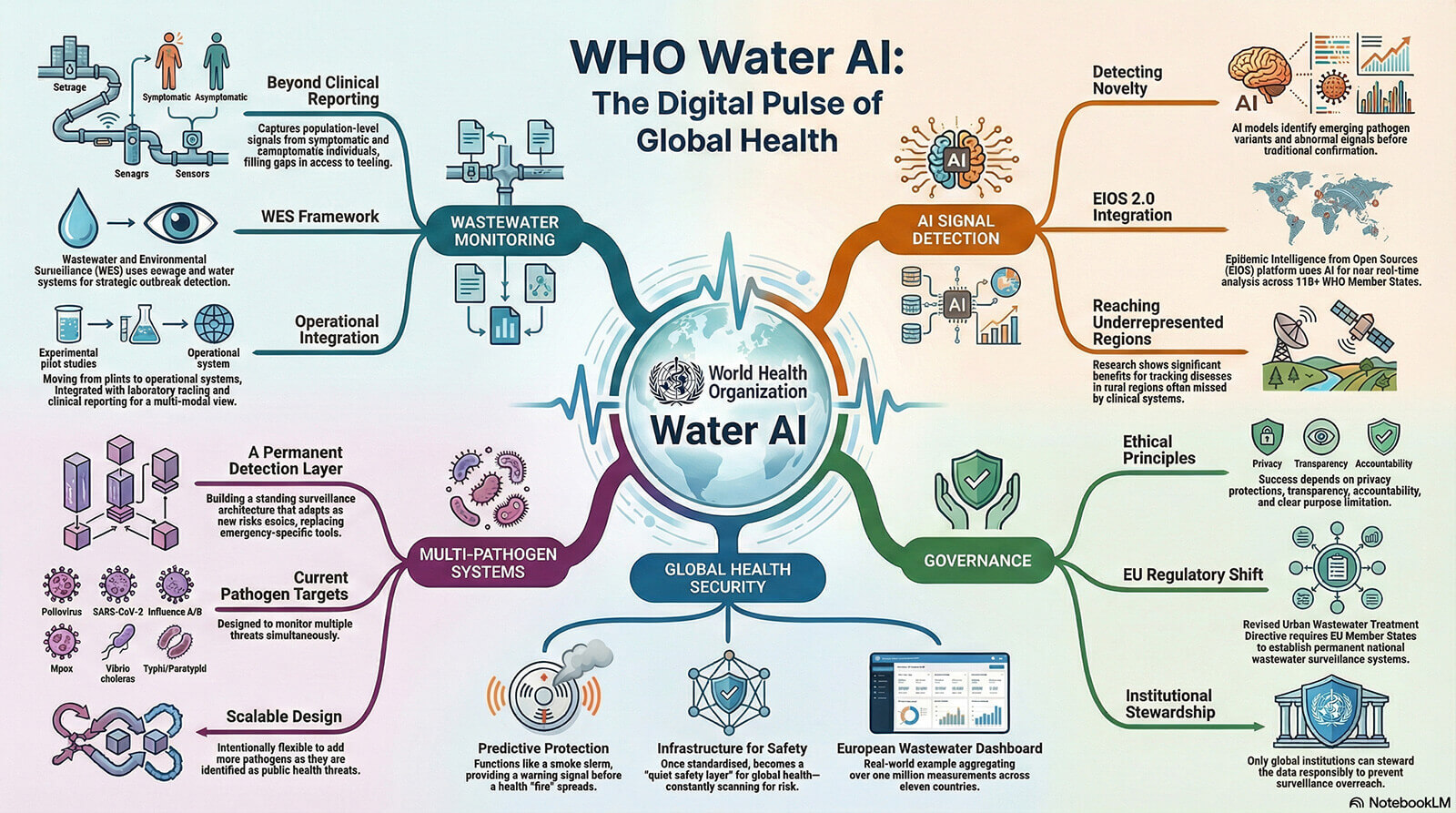
WHO’s pilot guidance on Wastewater and Environmental Surveillance (WES) formalizes that idea. Wastewater is no longer treated as a side channel. Instead, it becomes part of the intelligence layer that supports outbreak detection.
Wastewater as Population-Level Signal
WHO defines WES as surveillance using sewage systems or other human-impacted waters, especially in areas with limited sewer coverage. That definition sounds technical. Yet the implication is strategic.
Wastewater monitoring now integrates into multi-modal surveillance systems alongside laboratory testing and clinical reporting. Therefore, it stops being experimental and starts becoming operational.
This continuity matters. Stable data streams allow pattern detection. And pattern detection is what makes advanced analytics valuable.
A Standing, Multi-Pathogen Capability
While COVID-19 accelerated adoption, WHO’s guidance does not focus on a single pathogen. Instead, it supports prioritization across current and future threats.
The framework references poliovirus, SARS-CoV-2, influenza A and B, mpox virus, Vibrio cholerae, and Typhi/Paratyphi. Additional pathogens are expected to follow.
That design choice changes the conversation. Instead of building temporary systems for each emergency, WHO is shaping a standing surveillance capability. In practical terms, that architecture aligns with the logic behind World Health Organization Water AI: a persistent detection layer that adapts as risks evolve.
Why World Health Organization Water AI Is Moving Beyond Pilot Programs
Momentum is no longer theoretical.
In early 2025, the European Commission launched the European Wastewater Surveillance Dashboard, developed by the Joint Research Centre with the Health Emergency Preparedness and Response Authority. The platform aggregates more than one million measurements across eleven countries and tracks pathogens including SARS-CoV-2, RSV, and influenza.
At the same time, a revised Urban Wastewater Treatment Directive now requires Member States to establish national wastewater surveillance systems. Standardization transforms pilots into permanent infrastructure.
Once data collection becomes continuous, AI systems gain reliability. They operate on systems rather than snapshots.
AI Is Shifting from Analysis to Anticipation
The shift is no longer about analyzing water data. It is about detecting novelty before confirmation arrives from clinics.
Research collaborations involving the University of Nevada, Las Vegas and the Desert Research Institute describe AI-driven wastewater models capable of identifying emerging pathogen variants earlier than traditional case reporting. The findings, published in Nature Communications, highlight potential benefits for rural regions that often remain underrepresented in disease tracking systems.
Meanwhile, WHO upgraded its Epidemic Intelligence from Open Sources (EIOS) platform to version 2.0. The system now integrates AI-powered signal detection and near real-time analysis across more than 110 Member States. During that upgrade, WHO noted that the world is entering a new phase in how it collaborates, innovates, and responds to health threats.
When AI-enhanced epidemic intelligence intersects with structured wastewater surveillance, World Health Organization Water AI begins to resemble infrastructure rather than ambition.
Governance Will Shape the Future of World Health Organization Water AI
However, technical capacity alone does not determine success.
WHO emphasizes that wastewater surveillance must align with ethical principles of public health surveillance. Privacy protections, transparency, accountability, and clear purpose limitation remain central.
The stronger early-warning systems become, the more they depend on public trust. Without governance, even well-designed systems risk losing legitimacy.
Technology can detect signals. Only institutions can steward them responsibly.
The Quiet Layer Beneath Public Health
Wastewater surveillance cannot connect individuals directly to care. WHO acknowledges this limitation. Yet its strength lies in early detection.
Smoke alarms do not extinguish fires. They warn before damage spreads.
If multi-pathogen wastewater monitoring continues to expand and AI systems continue to mature, World Health Organization Water AI may become the quiet safety layer beneath global public health—rarely visible, yet constantly scanning for risk.
The remaining question is not whether the system can function.
It is whether global institutions will choose to make it standard.
Want More on World Health Organization Water AI and AI Governance?
World Health Organization Water AI does not evolve in isolation. As wastewater intelligence scales and AI-powered surveillance systems mature, governance frameworks become just as important as technical capability.
From European regulatory shifts to global institutional debates, the rules shaping AI deployment in public systems are changing rapidly. Explore how the European Union is redefining AI accountability in our analysis of the Google EU AI Act and the growing regulatory battle over AI infrastructure.
Frequently Asked Questions:
What is World Health Organization Water AI?
World Health Organization Water AI describes the emerging integration of wastewater monitoring, environmental surveillance, and AI-powered health intelligence systems supported by WHO frameworks. While it is not an official product name, it reflects how AI in public health increasingly relies on wastewater data to detect outbreaks earlier and support faster response.
How does AI wastewater surveillance detect outbreaks earlier?
AI wastewater surveillance analyzes patterns in sewage samples to identify abnormal pathogen signals. Because wastewater monitoring captures both symptomatic and asymptomatic infections, AI health surveillance systems can flag potential outbreaks before clinical case numbers rise.
Is wastewater monitoring more effective than traditional health surveillance?
Wastewater monitoring does not replace clinical reporting. Instead, it complements it. Traditional systems depend on individuals seeking care, whereas AI early warning systems built on wastewater data can provide population-level signals regardless of testing access.
What pathogens can World Health Organization Water AI systems monitor?
WHO’s Wastewater and Environmental Surveillance framework supports multi-pathogen detection. Current targets include poliovirus, SARS-CoV-2, influenza A and B, mpox virus, Vibrio cholerae, and Typhi/Paratyphi. The structure is designed to expand as new threats emerge.
How does AI improve epidemic intelligence systems?
AI enhances epidemic intelligence by processing large volumes of environmental, clinical, and open-source data in near real time. When integrated with wastewater surveillance, AI in public health shifts from reactive reporting toward predictive risk modeling.
What are the governance risks of AI-based water surveillance?
AI health surveillance systems raise concerns around privacy, transparency, and accountability. WHO emphasizes that wastewater monitoring must follow ethical public health principles and include safeguards to prevent misuse or surveillance overreach.