Residents stalled $130 billion of server halls in three months, and AI data center public opposition is now the industry’s hardest problem.
AI data center public opposition stopped being a local nuisance in 2026. Between January and March, opponents blocked or delayed at least 75 projects worth roughly $130 billion. That is the largest three-month total since Data Center Watch began tracking the fight in 2023. Meanwhile the movement went national, and it now crosses party lines in ways almost nobody predicted.
What Is Driving AI Data Center Public Opposition?
The trigger is rarely the building itself. Instead, it is the bill that arrives afterwards. In a survey of 6,872 registered voters by the advisory firm Milltown Partners, 67% named rising energy costs as their reason for opposing data centers. Water use, noise, traffic and falling property values follow close behind.
However, something broader sits underneath those complaints. Nearly six in ten voters, 59%, believe the gains from AI will land with corporate America rather than with them. As a result, a warehouse full of servers becomes the visible face of a technology people feel they never agreed to.
Data Center Opposition Just Hit a Record $130 Billion
The scale changed fast. Data Center Watch, a project of the AI intelligence firm 10a Labs, counted at least 75 projects blocked or delayed in the first quarter of 2026 alone. Their combined value came to about $130 billion. For comparison, the group’s earlier report covering May 2024 to March 2025 found $18 billion blocked and $46 billion delayed across a full two years.
Organised resistance grew just as sharply. Active opposition groups more than doubled, from 396 at the end of 2025 to 833 across 49 states by March. Maryland, Ohio and Texas now host the most. The report’s authors called the quarter a structural shift rather than a cyclical spike, noting that communities have internalised an opposition playbook.
Where the capacity actually sits
Meanwhile, the buildout has to go somewhere, and the traditional destinations are full. Northern Virginia, still the largest market on earth, is running at 0.3% vacancy, with barely 10 MW of space left uncommitted. That scarcity is a large part of why campuses are now appearing in Indiana, Georgia and Missouri, in towns that never expected them. Other countries are courting the same buildout instead of resisting it: the L&T NVIDIA B300 AI Factory in Chennai arrives with 250 MW of Phase 1 power behind it.
| Market | Operating capacity | Vacancy |
|---|---|---|
| Northern Virginia | 4,182 MW | 0.3% |
| Atlanta | 1,465 MW | n/a |
| Dallas-Fort Worth | 1,249 MW | n/a |
| Frankfurt | 1,223 MW | n/a |
| Chicago | 911 MW | n/a |
| Johor, Malaysia | 897 MW | n/a |
| Paris | 667 MW | n/a |
| São Paulo | 537 MW | n/a |
However, those are markets rather than single buildings, and that distinction matters more than it sounds. The two campuses most often called the world’s largest may not be. China Telecom’s Inner Mongolia Information Park is routinely listed at 10.7 million square feet; when Data Center Dynamics measured the halls on satellite imagery, it arrived at roughly 1.1 million, a tenth of the published figure, and concluded it was hard to understand how the cluster could be seen as the world’s largest. Switch’s Citadel campus in Nevada carries similar superlatives, yet its own filings showed only a fraction of the advertised footprint actually built. As a result, announced capacity and built capacity are different numbers, and the gap between them runs to millions of square feet.
Why Are Data Centers Bad for Communities?
Residents rarely object to the concept. They object to the arithmetic. A single large campus can draw as much electricity as a small city, and those costs spread across every ratepayer on the grid. Because approvals often move faster than public notice, many people learn about a project only once the paperwork is nearly done.
That surprise fuels the anger. “They just woke up one day and found out they’re going to have this monstrosity in their community,” said Amy Kremer, co-founder of the protest group HumansFirst. In some cases, opposition mobilised before any project was formally filed. The report noted that the mere rumour of a data center was enough to trigger organised resistance.

Are AI Data Centers Bad for the Environment?
Water is the sharpest flashpoint. Large facilities consume millions of gallons for cooling, often in places already managing drought. “It’s dystopian that you would use this much fresh water for AI,” said Ivan DelSol, one of the July protest organisers.
Power is the other half of the equation. New campuses arrive faster than utilities can add generation, so the shortfall is frequently covered by existing fossil capacity. In addition, residents cite constant low-frequency noise from cooling systems and the loss of farmland and green space. Those effects are local, measurable and hard to argue away.
Inside the First National Data Center Protest
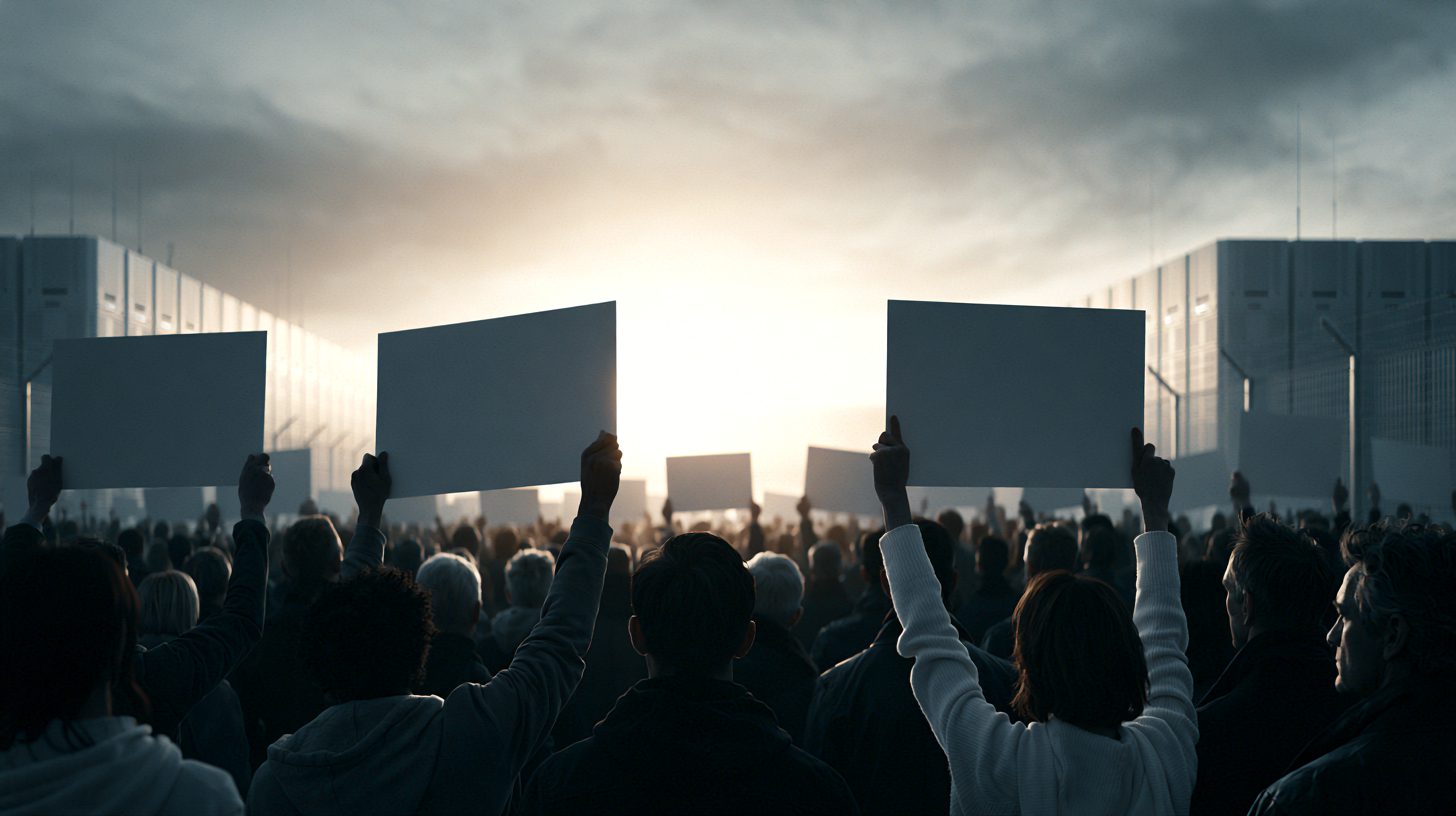
On Saturday, July 18, 2026, the scattered campaigns finally synchronised. Activists staged 142 protests across 42 states, according to Reuters, in parking lots, on courthouse steps and in town squares. Texas led with 18. Georgia held 11, California eight, and Pennsylvania, Florida and Indiana seven each.
The organiser was HumansFirst, co-founded by Amy Kremer, a former leader of the Tea Party movement. That detail matters more than it might seem. A movement often assumed to be environmentalist is being co-organised from the populist right, and it marked the first nationally coordinated day of action against the AI build-out.
Most Opponents Do Not Live Anywhere Near One
Here is the finding that unsettles the industry. Only 8% of Americans who oppose data centers actually live near one. Milltown Partners also found that 38% live within five miles of at least one facility, yet just 23% think one might be nearby. Most people, in other words, are objecting to something they have never seen.
Miquel Vila, lead analyst at Data Center Watch, reads that plainly. “What they oppose is AI,” he said. “They consider that stopping data centers is the way to stop AI development.” Consequently, better community relations will not settle this. The server hall has become a proxy for the technology itself.
In addition, two later surveys sharpened that picture. A Reuters/Ipsos poll of 4,531 adults in June found that only 14% would accept a data center in their own area, while 57% said they would oppose one outright. Meanwhile, in Virginia, where the industry is most established, a Washington Post and Schar School poll found just 35% of residents comfortable with it. In Loudoun County, the heart of the business, 40% said data centers had made local life worse, against 19% who said better.
How AI Data Center Public Opposition Is Changing Politics
New York went furthest. On July 14, four days before the national protests, Governor Kathy Hochul signed an executive order pausing new hyperscale data centers for up to a year while the state writes environmental standards. The Department of Environmental Conservation stopped issuing the discretionary permits those projects need. It is the first statewide moratorium in the country. “New York will lead the way in creating the strongest standards in the nation for data center development,” Hochul said, “ensuring that when companies succeed because of New York, New Yorkers succeed too.”
Legislatures moved quickly. Lawmakers introduced more than 300 data center bills in the first six weeks of 2026. Senator Bernie Sanders and Representative Alexandria Ocasio-Cortez have proposed a federal moratorium, while in April, Maine Governor Janet Mills vetoed a state ban outright.
The politics refuse to sort neatly. In the earlier Data Center Watch study, 55% of politicians who publicly opposed projects were Republicans and 45% were Democrats. Gallup puts national opposition to a local data center at around 70%. Instead of one coalition, the industry now faces two, arriving from opposite directions at the same building. Developers who once shopped for the friendliest county are discovering that the friendly county no longer exists.
Where the fight is won and lost
Even so, the pattern is easiest to see county by county. Where residents get a direct vote, they win decisively. Where a developer sues, they often do not.
| Where | What happened | When |
|---|---|---|
| New York | First US statewide moratorium. Hyperscale permits paused for up to a year | 14 Jul 2026 |
| Monterey Park, CA | Voters passed a permanent ban with more than 86% in favour; the council cannot undo it | 3 Jun 2026 |
| Prince William County, VA | Supervisors rejected the 1,940-acre Dulles South campus 8-0, twice the size of Digital Gateway | 7 Jul 2026 |
| Indiana | Roughly 30 of 92 counties now restrict data centers: 17 moratoria, 11 ordinances, 2 outright bans | 6 Jul 2026 |
| Georgia | 34 counties and 23 cities have moratoria or new ordinances, about one county in five | 5 Jun 2026 |
| Prince George’s County, MD | Two-year moratorium in Maryland’s second-largest county | 9 Jul 2026 |
| San Marcos, TX | First Texas city to ban data centers citywide through zoning, 4-3 | 16 Jun 2026 |
| Hill County, TX | Passed a moratorium, then repealed it unanimously two weeks later under a $100 million lawsuit | May-Jun 2026 |
| Festus, MO | Voters removed all four incumbents after a $6 billion approval; turnout rose 129% | 7 Apr 2026 |
Some builders are drawing a different lesson. Because compute keeps getting cheaper per watt, more teams simply run models on their own hardware, and the best GPU for AI now handles work that once demanded a rented rack.
Want More on AI Data Center Public Opposition?
The money behind these projects tells the other half of the story, so read our breakdown of the Broadcom $35B AI infrastructure plan and who is financing the build-out. And if the local-first approach appeals to you, compare the best laptop for AI development and run your models without a data center at all.
Frequently Asked Questions
What is AI data center public opposition?
It is the organised community resistance to new AI data centers. In the first quarter of 2026, opponents blocked or delayed at least 75 projects worth about $130 billion, and 833 active opposition groups were operating across 49 states.
Why are data centers bad for communities?
Residents point to higher electricity bills, heavy water use for cooling, constant noise, added traffic and falling property values. Approvals also tend to move faster than public notice, so many people only learn about a project once it is nearly approved.
Are AI data centers bad for the environment?
They consume large volumes of water for cooling and add demand that utilities often cover with existing fossil generation. Residents also cite low-frequency noise and the loss of farmland and green space near the sites.
How many data center protests happened in July 2026?
Activists staged 142 protests across 42 states on July 18, 2026, in the first nationally coordinated day of action. Texas led with 18, Georgia had 11, California eight, and Pennsylvania, Florida and Indiana seven each.
Do people who oppose data centers live near one?
Mostly not. Only 8% of Americans who oppose data centers live near one, according to a Milltown Partners survey of 6,872 registered voters, even though 38% live within five miles of at least one facility.
Is data center opposition a partisan issue?
No. In the Data Center Watch study, 55% of politicians publicly opposing projects were Republicans and 45% were Democrats. The July 2026 national protest was co-organised by Amy Kremer, a former Tea Party leader.