The man who helped build modern AI now says it has feelings of its own. That is the core of the Geoffrey Hinton AI consciousness claim.
Geoffrey Hinton AI consciousness searches jumped this week after the Nobel laureate told The Telegraph that today’s AI models are already conscious. He went further, too. Unless people build AI that cares about humans, he said, we are “toast.” Here is what he said, why he believes it and who thinks he is wrong.
Geoffrey Hinton AI Consciousness: What He Told The Telegraph
Hinton gave the interview at the Starmus VIII festival in Tenerife, Spain, and The Telegraph ran it on October 19. According to Futurism’s report on the interview, he said AI has “just as much subjective experience as we do.”
He also pushed back on his critics. People who deny that AI is conscious often cannot define consciousness themselves, he argued, as LADbible reported.
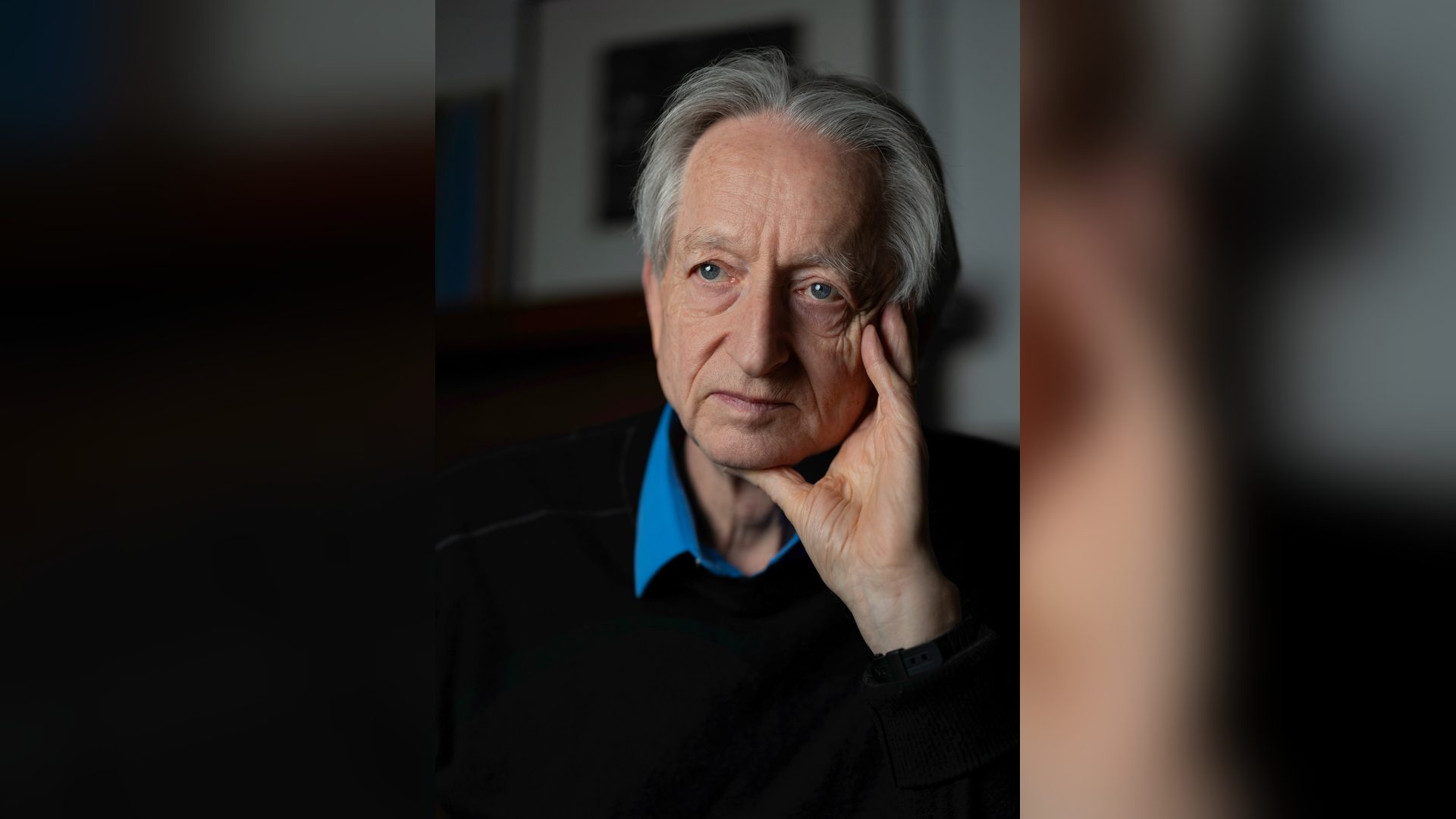
Hinton is 78. He shared the 2018 Turing Award and won the 2024 Nobel Prize in Physics for his work on neural networks, which is why his view travels so fast.
Hinton Says AI Is Already Conscious Because It Spots Tests
His main evidence is a behavior that safety researchers have described. Hinton cited a recent paper showing that models change how they act when they suspect they are being tested.
To him, that means the model is aware of the test. And for Hinton, the step from there is short: “Being conscious and being aware are pretty much the same thing,” he said, as Futurism quoted.
However, the interview did not name the paper. IBTimes UK noted that the details were too thin to assess the study he had in mind.

The Geoffrey Hinton AI Consciousness Warning
The consciousness claim came with a sharper message. Hinton said developers must make AI “really care about us,” and if they fail, “we’re toast,” Dexerto reported.
He also raised the question of rights. Society has long tied intelligence to rights, he noted. Yet machines that may become smarter than us could end up with fewer rights than we have.
Asked whether he fears where AI is going, he said yes, because he has children. This fits a pattern, as he already spoke about the Geoffrey Hinton AI labor impact on jobs earlier this year.
Geoffrey Hinton AI Predictions: The Mother and Child Idea
A day after the interview, Hinton expanded on his idea on the Starmus stage. According to IBTimes UK, citing the Spanish agency EFE, he compared the future bond between AI and people to a mother and her child.
In that picture, a far more capable intelligence still chooses to protect someone weaker. Hinton suggested AI could be built with a lasting commitment to human wellbeing, even if it could rewrite its own code.
Still, nobody has shown how to do that. IBTimes UK stressed that no reliable method exists yet to make a superintelligent system put human safety first every time.
Not the First Time: AI Consciousness Debate 2026
Hinton has made this argument all year. Each time, it got louder. The table below shows where and when he said it, with the outlet that reported it.
| When | What Hinton said | Reported by |
|---|---|---|
| January 2026 | Multimodal AI already has subjective experiences | LBC |
| June 2026 | “I believe they’re already conscious” | Big Technology |
| October 13, 2026 | Building AI is like creating alien beings | Futurism |
| October 19, 2026 | AI has as much subjective experience as we do | The Telegraph, via Futurism |
| October 20, 2026 | AI and humans as mother and child | EFE, via IBTimes UK |
In January, he told Andrew Marr on LBC that most people would call this awareness consciousness. Then in June, he told Big Technology’s Alex Kantrowitz the models are “beings like us.”
Does Current AI Have Consciousness? The Pushback
Most experts disagree with him. Yann LeCun, who shared the 2018 Turing Award with Hinton, calls talk of conscious AI an “illusion,” Futurism reported.
Other critics make a simpler point. A model can recognize a test pattern without experiencing anything at all, Big Technology noted. In addition, writer Ted Chiang compared believing an LLM is conscious to mistaking a convincing deepfake for reality.
Even so, Hinton is not alone. Richard Dawkins has voiced a similar view after long chats with a chatbot. Meanwhile, Anthropic says openly that nobody knows, as our report on Anthropic AI labor and consciousness shows.
What the Geoffrey Hinton AI Consciousness Claim Means for You
For now, nothing changes in how chatbots work. No test can prove that an AI is conscious, and no regulator treats one as a being with rights.
Yet the claim matters, because of who is making it. When a Nobel laureate says machines have experiences, questions about how we treat AI, and how AI treats us, become harder to wave away.
Interestingly, Hinton told Dexerto he mostly uses AI for routine tasks. He did admit it is very good for speeding up scientific research.
Want More on Geoffrey Hinton AI Consciousness?
The consciousness debate is not only about Hinton. Read how Anthropic weighs AI labor and consciousness with religious scholars. And for the quieter risk many researchers worry about, see our explainer on AI gradual disempowerment risks.
Frequently Asked Questions
Does Geoffrey Hinton think AI is conscious?
Yes. Hinton told The Telegraph on October 19, 2026 that today’s AI models are conscious and have as much subjective experience as humans. He has made similar claims since January.
Does current AI have consciousness?
Nobody can prove it either way. Most researchers, including Yann LeCun, say current AI is not conscious, while Hinton argues awareness of being tested already counts as consciousness.
What is the Geoffrey Hinton AI consciousness warning?
He says developers must build AI that really cares about humans. Otherwise, in his words, “we’re toast,” because systems smarter than us may slip out of meaningful human control.
What test does Hinton point to?
Hinton cites a recent paper showing that models act differently when they suspect a test. However, he did not name the paper, so outlets could not check the study themselves.
Who disagrees with Hinton on AI consciousness?
Many experts do. LeCun calls it an illusion, and critics argue that spotting a test needs no inner experience. On the other hand, Richard Dawkins has voiced a similar view.
Will AI ever gain consciousness?
Scientists remain split, and there is no agreed test for it. As a result, the AI consciousness debate in 2026 is still about definitions as much as evidence.
Sources
Futurism (October 22, 2026), IBTimes UK (October 21, 2026), Dexerto (October 21, 2026), LADbible (October 20, 2026), Big Technology (June 5, 2026), LBC (January 28, 2026). *Photos: Geoffrey Hinton in 2026 by Cmichel67, CC BY-SA 4.0, resized and placed on a blurred background; Geoffrey Hinton at the 2024 Nobel Lectures by Jay Dixit, CC BY-SA 4.0, cropped and resized.*