Claude Sonnet 5 points toward a future where agentic coding becomes a default, not an experiment.
Anthropic is preparing to release the next evolution of its Sonnet model line. Early signals suggest that Claude Sonnet 5 will focus on agentic coding, marking a shift toward more autonomous AI coding workflows rather than simple code assistance.
Rather than treating this release as a raw performance upgrade, Anthropic is refining how AI models reason, plan, and act across complex software tasks. This direction reflects a broader move within AI development: building systems that can manage structured processes, not just generate responses.
Beyond AI coding assistance with Claude Sonnet 5
Previous Sonnet models earned a strong reputation for balanced performance. They were fast, reliable, and effective for AI coding tasks such as code generation, explanation, and collaborative pair programming. However, modern software development increasingly demands more than isolated prompts.
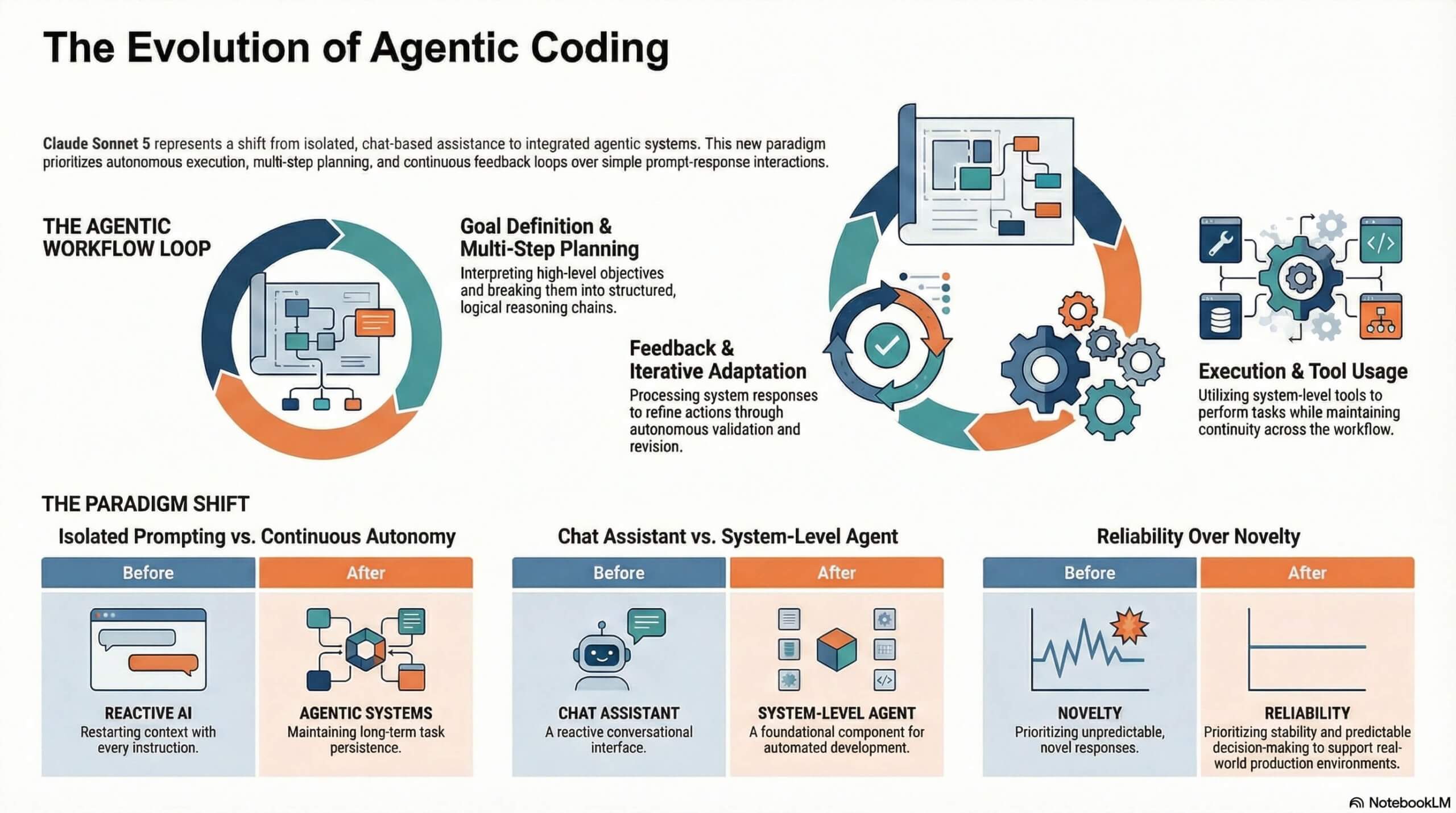
With this Sonnet release, the emphasis shifts toward autonomous workflows. Agentic coding means the model interprets a goal, breaks it into steps, uses tools where needed, and adjusts its approach when conditions change. Rather than reacting to every instruction, the AI operates with greater continuity and intent.
This approach aligns with how real development teams work. Software projects involve iteration, dependency management, testing, and revision. An AI model built for agentic coding fits more naturally into that environment.
Why agentic coding matters for AI developers
Agentic coding is becoming central to how AI systems are deployed in production. Autonomous AI agents reduce repetitive overhead, accelerate development cycles, and allow teams to focus on architectural and strategic decisions.
In this context, this Sonnet model positions itself as more than just another AI coding model. It enables longer, multi-step reasoning and more reliable tool usage, which are essential for AI agents handling complex tasks.
For teams building AI agents, internal automation tools, or developer-focused platforms, this shift toward autonomous AI workflows is especially relevant. Models optimized for agentic behavior perform better in real-world software development, where consistency matters more than flashy output.
A system-level approach to AI coding
What stands out about Claude Sonnet 5 is the attention to system-level reasoning. Rather than emphasizing novelty, the model focuses on structure, sequencing, and predictable behavior across extended workflows.
This suggests Anthropic is prioritizing reliability and stability. In practice, that means fewer fragile interactions and more dependable performance when teams embed the model into larger systems. For professional AI development, that reliability is often more valuable than marginal benchmark gains.
This makes the new Sonnet model not a chat upgrade, but a foundational component for agent-based AI systems.
What comes next
Anthropic has not yet released full technical specifications or benchmarks. As a result, expectations should remain grounded. Still, the direction is clear. This Sonnet model sits at the intersection of AI coding, autonomous workflows, and agentic systems.
As agentic coding moves from experimentation into everyday use, models designed around this paradigm will shape how software is built and maintained. Claude Sonnet 5 signals that future clearly.
The official launch will reveal more details. Until then, Claude Sonnet 5 already points to where AI-assisted development is heading next: toward systems that do not just respond, but act.
Want more on Claude Sonnet 5 and agentic coding?
As Claude Sonnet 5 points toward more autonomous AI systems, the AI landscape already shows similar shifts. The evolution of Openclaw AI shows how assistants are moving beyond simple chat interactions toward persistent, agent-like behavior.
At the same time, agentic coding naturally connects with broader automation trends, where an AI workflow automation tool helps coordinate complex, multi-step execution with minimal human intervention.
Frequently Asked Questions:
What is Claude Sonnet 5?
Claude Sonnet 5 is the upcoming AI model in the Sonnet line developed by Anthropic. The model supports advanced reasoning, AI coding, and agentic workflows, with a stronger emphasis on autonomy than previous Sonnet versions.
When will Claude Sonnet 5 be released?
Anthropic has not announced an official release date. Current signals suggest that Claude Sonnet 5 will launch soon.
What makes Claude Sonnet 5 different from previous Sonnet models?
Earlier Sonnet models focused on fast and reliable AI assistance. Claude Sonnet 5 shifts that focus toward agentic coding, with improved planning, longer reasoning chains, and more consistent behavior across complex, multi-step tasks.
What is agentic coding?
Agentic coding describes AI systems that understand a goal, break it into steps, use tools when needed, and adapt during execution. Instead of responding to isolated prompts, the AI operates with greater autonomy and continuity.
Is Claude Sonnet 5 designed for AI agents?
Yes. Claude Sonnet 5 serves as a foundation for AI agents that operate across autonomous workflows, structured software processes, and multi-step execution scenarios.
What can we expect after Claude Sonnet 5 launches?
After launch, Anthropic will reveal more details about real-world performance, use cases, and system integration. The release should clarify how Claude Sonnet 5 fits into the broader shift toward agentic AI workflows.