Disclosure: this article contains affiliate links. If you buy through them, we may earn a commission at no extra cost to you. It never decides our picks. Affiliate Disclosure · How we use AI
Bright rooms, big screens, serious gaming, our Samsung QN80F review tests the mini-LED that promises all three.
What Is the Samsung Neo QLED QN80F?
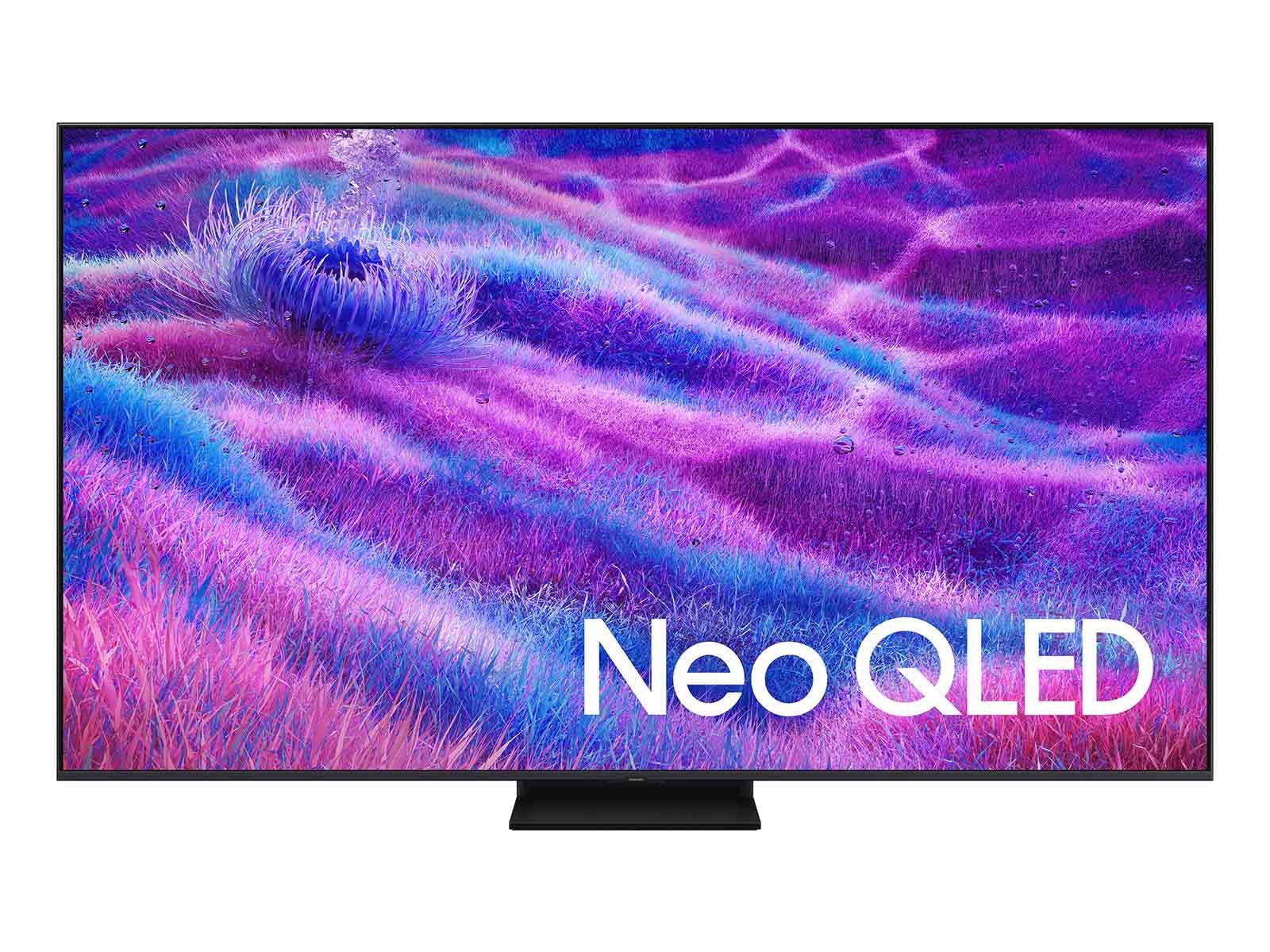
This Samsung QN80F review sizes up the Samsung QN80F, which is the mid-range model in Samsung’s 2025 Neo QLED line, above the entry QN70F, below the QN85F and the flagship QN90F. Neo QLED means a mini-LED backlight: thousands of tiny LEDs in dimmable zones behind a quantum-dot panel, built for brightness LCD-style rather than OLED-style.
The 2025 generation runs Samsung’s NQ4 AI Gen2 processor with 4K AI upscaling and Real Depth Enhancer, plus the new Vision AI features: Click-to-Search for on-screen lookups and Live Translate for real-time subtitle translation. Sizes run from 55 up to a wall-filling 100 inches.
This Samsung QN80F review weighs what you get, and what the step down from the QN90F really costs.
Samsung QN80F Price and Where to Buy
Launch pricing started at $1,299 for the 55-inch, $1,799 for the 65-inch and up to $5,999 for the 100-inch. Like most Samsung sets, street prices drop fast after launch, so checking live listings usually beats the MSRP by a comfortable margin.
Because the QN80F sits mid-lineup, it is frequently the sweet spot in Neo QLED promotions, close to QN90F sizes for QN70F money when discounts land. We link to current listings below.
Samsung QN80F Price by Size: 55, 65, 75, 85 and 100 Inch
For this Samsung QN80F review we checked Samsung’s US store on October 13, 2026. The launch prices above are history now, because every size has dropped sharply.
| Size | US model | Price (Oct 2026) | Launch price |
|---|---|---|---|
| 55 inch | QN55QN80FAFXZA | $799.99 | $1,299.99 |
| 65 inch | QN65QN80FAFXZA | $1,199.99 | $1,799.99 |
| 75 inch | QN75QN80FAFXZA | $1,299.99 | $2,299.99 |
| 85 inch | QN85QN80FAFXZA | $1,999.99 | $3,499.99 |
| 100 inch | QN100QN80FFXZA | $3,999.99 | $5,999.99 |
The 75 inch is the standout, since it costs only $100 more than the 65 inch. In addition, Costco and Sam’s Club sell a warehouse version called the QN80FD, which adds a longer warranty.
There is a reason for the discounts. According to RTINGS, the QN80F was replaced in 2026 by the QN80H. Therefore the QN80F is now a clearance model, and that makes it a better deal than it was at launch. For that reason this Samsung QN80F review rates its value higher today than in spring.
Picture Quality: Mini-LED Brightness With a Catch
TechRadar measured the Samsung QN80F at 1,106 nits peak HDR in Movie mode, solid, though notably below the flagship QN90F’s ~2,086 nits. The real surprise is full-screen brightness: up to 869 nits in Standard mode, which is enormous for daytime viewing and one of the QN80F’s genuine superpowers.
Colors are vibrant yet natural, detail refinement is strong, and contrast is respectable for the class, though blacks can lift slightly and mini-LED zone transitions occasionally show. The catch: the screen is standard gloss rather than the QN90F’s Glare Free finish, so reflections are visible in very bright rooms. And, as with all Samsung TVs, there is no Dolby Vision, HDR10+ stands in.
Vision AI and the NQ4 AI Gen2 Processor
The NQ4 AI Gen2 chip handles 4K AI upscaling well, cleaning up HD streams convincingly, while Real Depth Enhancer adds dimensionality to flat-looking content.
Vision AI is the 2025 party trick, and it is more useful than gimmicky. Click-to-Search identifies actors, products and places on screen; Live Translate converts subtitles in real time on live broadcasts; and the AI mode tunes picture and sound scene by scene. Meanwhile, the TV doubles as a SmartThings hub with Bixby and Alexa built in.
Gaming Performance: A Genuine Strength
Gaming is where the QN80F shines brightest. All four HDMI ports are full HDMI 2.1, supporting 4K at up to 144Hz with AMD FreeSync Premium Pro and ALLM. Measured input lag is an ultra-low 9.9ms, flagship territory.
In addition, the high full-screen brightness keeps HDR games punchy even in daylight, and Samsung’s Gaming Hub streams cloud titles without a console. For a living-room gamer, this is one of the best mini-LED packages under flagship money.
Sound, Tizen 9.0 and Everyday Use
Object Tracking Sound Lite moves audio with the action and supports Dolby Atmos, delivering clear dialogue and decent spatial cues, though bass remains TV-thin. Q-Symphony pairs the speakers with a Samsung soundbar if you upgrade.
Tizen 9.0 is the best version of Samsung’s platform yet, quicker, cleaner, with every major app plus 2,700+ free Samsung TV Plus channels. Daily use feels polished and fast.
QN80F vs QN90F: What the Step Down Costs
The honest context for this Samsung QN80F review. The flagship QN90F roughly doubles peak HDR brightness (~2,086 vs ~1,106 nits), adds the Glare Free matte screen and finer local dimming. The QN80F counters with a lower price, the same gaming feature set, the same Vision AI and that excellent full-screen brightness.
If you watch lots of HDR movies in a controlled room, the QN90F’s headroom is worth stretching for. For bright-room TV, sports and gaming, the QN80F covers 90% of the experience for meaningfully less.
Samsung QN80F vs QN70F: Which Neo QLED to Buy
The QN70F sits one step below, and many shoppers compare the two. Both are Neo QLED sets with Vision AI, Tizen and 144Hz gaming. However, the backlights are far apart.
The QN70F measured about 625 nits in HDR and uses a simpler dimming system with few zones. Meanwhile the QN80F reaches roughly 1,106 nits and controls its backlight with far more precision. As a result, HDR highlights and dark scenes look clearly better on the QN80F.
So the choice in this Samsung QN80F review is simple. If you watch mostly daytime television and want the lowest price, the QN70F is enough. If you care about HDR movies or play in a dim room, the QN80F is worth the step up. Our Samsung QN70F review has the full numbers for the cheaper set.
Real-World Viewing: Built for the Daytime
Live with the QN80F and a pattern emerges fast: this TV is happiest with the lights on. Daytime sports are its signature dish. That ~869-nit full-screen brightness keeps a sunlit Saturday game punchy in a way OLEDs simply cannot, and motion stays composed on fast breaks.
Evening movies are good rather than great. Colors stay rich and the mini-LED zones handle most scenes cleanly, yet letterbox bars lift slightly and a starfield will betray the zone count. Streaming HD content upscales nicely through the NQ4 chip, and Vision AI’s Click-to-Search earns surprising regular use, identifying an actor mid-episode becomes a habit.
In short, the QN80F’s real-world character matches its measurements: a daylight powerhouse with respectable, not reference, dark-room manners.
Setup and the Settings That Matter
Out of the box, Standard mode is bright but cool; Movie mode is the accuracy pick for films, and Game Mode engages automatically with consoles. Intelligent Mode, Samsung’s AI optimization, is genuinely worth leaving on for mixed daily viewing, adapting brightness and sound to the room.
Two practical tips from this review: disable the most aggressive motion smoothing for films (Picture Clarity settings), and if reflections bother you, bias the TV away from facing windows, the gloss screen rewards smart placement. Setup itself, via SmartThings on your phone, takes minutes.
Samsung QN80F Specs at a Glance
The essentials:
- Panel: 4K Neo QLED (mini-LED, Quantum Matrix) with quantum dots
- Processor: NQ4 AI Gen2 with 4K AI Upscaling and Real Depth Enhancer
- Peak HDR: ~1,106 nits (10% window); full-screen up to ~869 nits
- HDR: HDR10+, HDR10, HLG (no Dolby Vision)
- Gaming: 144Hz, 4x HDMI 2.1, FreeSync Premium Pro, ~9.9ms input lag
- Audio: Object Tracking Sound Lite, Dolby Atmos, Q-Symphony
- Platform: Tizen 9.0, Vision AI, SmartThings hub, Bixby + Alexa
- Sizes: 55, 65, 75, 85, 100 inches
How Samsung Neo QLED QN80F Compares
Pros and Cons
What we liked
- Excellent full-screen brightness (~869 nits) for daytime viewing
- Ultra-low 9.9ms input lag with 144Hz on all 4 HDMI 2.1 ports
- Vision AI: Click-to-Search and Live Translate genuinely useful
- Vibrant, natural quantum-dot color
- Tizen 9.0 is fast and complete
- Huge size range up to 100 inches
What could be better
- Peak HDR well below the QN90F (and some cheaper mini-LED rivals)
- Glossy screen reflects in very bright rooms
- No Dolby Vision (HDR10+ only)
- Occasional mini-LED blooming and zone transitions
Who Should Buy the Samsung QN80F?
Buyers with bright living rooms who want big, punchy pictures all day, sports, news, daytime TV, and gamers who will use the 144Hz/9.9ms combo. It is also the value route into Vision AI and a genuine mini-LED backlight without flagship spend.
Dark-room movie purists should look at OLED instead (see our LG C5 review), and HDR maximalists should stretch to the QN90F. Dolby Vision devotees will need to accept HDR10+ or shop elsewhere.
Final Verdict: Is the Samsung QN80F Worth It?
The Samsung QN80F is a very good mid-range mini-LED with two standout talents, daylight-proof full-screen brightness and flagship-grade gaming response, wrapped in Samsung’s best software to date. It is not the HDR-peak champion, and the gloss screen is an odd pairing for a bright-room TV, but at street prices it delivers a lot of Neo QLED for the money.
Want More After This Samsung QN80F Review?
Compare it against OLED and the rest of the 2026 field in our roundup of the best AI smart TVs, or read the LG C5 review to see how the OLED alternative trades blows.
Frequently Asked Questions
Is the Samsung QN80F worth it?
Yes, for bright rooms and gaming. It pairs ~869 nits of full-screen brightness with 144Hz and a 9.9ms input lag at a mid-range price. HDR-movie purists may prefer the brighter QN90F or an OLED.
How bright is the Samsung QN80F?
About 1,106 nits peak HDR on a 10% window (TechRadar, Movie mode) and an unusually high ~869 nits full-screen in Standard mode, which makes daytime viewing a strength.
Does the Samsung QN80F support Dolby Vision?
No. Like all Samsung TVs it uses HDR10+ instead of Dolby Vision, alongside HDR10 and HLG.
Is the Samsung QN80F good for gaming?
Very. All four HDMI 2.1 ports run 4K at up to 144Hz with FreeSync Premium Pro and ALLM, and input lag measures around 9.9ms, among the best in its class.
Samsung QN80F vs QN90F: which should I buy?
The QN90F nearly doubles peak HDR brightness and adds a Glare Free matte screen. The QN80F matches the gaming features and Vision AI for less money. Movies in HDR favor the QN90F; bright-room TV and gaming value favor the QN80F.
What is Samsung Vision AI?
Samsung’s 2025 AI feature set: Click-to-Search identifies what is on screen, Live Translate converts subtitles in real time, and an AI mode optimizes picture and sound scene by scene.
What sizes does the Samsung QN80F come in?
55, 65, 75 and 85 inches, plus a 100-inch model in select markets.
How much does the Samsung QN80F cost?
As noted in our Samsung QN80F review, on Samsung’s US store in October 2026 it cost $799.99 for the 55 inch, $1,199.99 for the 65 inch, $1,299.99 for the 75 inch, $1,999.99 for the 85 inch and $3,999.99 for the 100 inch. Those prices are well below the launch figures.
What is the difference between the Samsung QN70F and QN80F?
Both are Neo QLED sets with 144Hz gaming and Vision AI. However, the QN80F is much brighter, at about 1,106 nits against roughly 625, and it has more precise local dimming. The QN70F costs less.
Is the Samsung QN80F good in a bright room?
Yes, in most rooms. RTINGS found it best in a moderately lit room and fine in a bright one, as long as no lamp or window sits directly opposite the screen, because it has a glossy finish. Our Samsung QN80F review reached the same conclusion.
What is the Samsung QN80FD?
The QN80FD is the version sold by Costco and Sam’s Club. It is the same television family with an extended warranty, and it comes in the same sizes.
Did the Samsung QN80H replace the QN80F?
Yes. Samsung replaced the QN80F with the QN80H in 2026. As a result, the QN80F is now sold at clearance prices, which makes it strong value while stock lasts.
Is the Samsung QN80F a mini-LED TV?
Yes. It belongs to Samsung’s Neo QLED range, which uses a mini-LED backlight with local dimming. It sits below the QN85F and QN90F in that range.