
Disclosure: this article contains affiliate links. If you buy through them, we may earn a commission at no extra cost to you. It never decides our picks. Affiliate Disclosure · How we use AI
If you want OLED’s perfect blacks without the flagship price, this LG C5 review lands on a simple verdict: it’s the sweet spot.
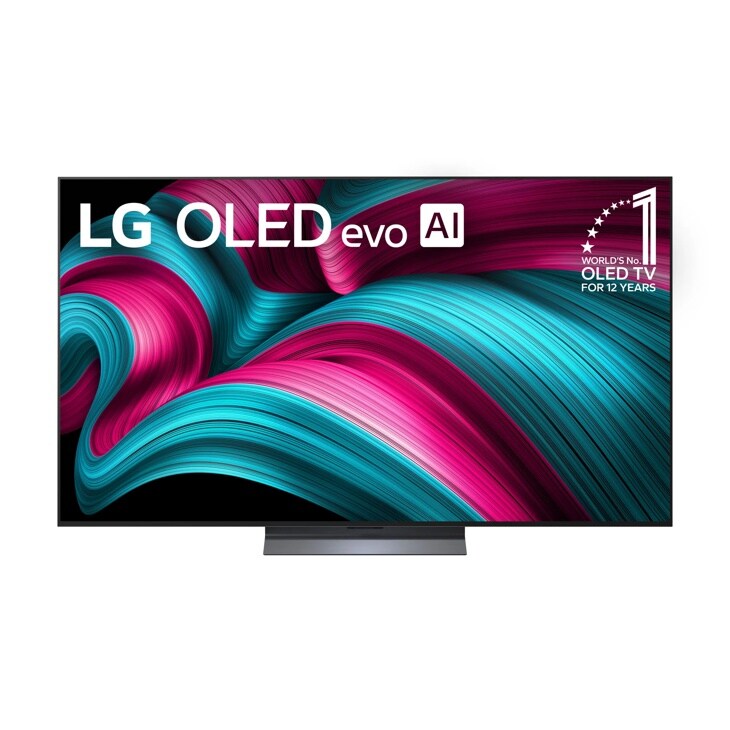
What Is the LG OLED evo AI C5?
This LG C5 review covers the LG OLED evo AI C5, which is LG’s 2025 mid-range OLED TV, and, for most people, the one to buy. In LG’s lineup it sits above the entry B5 and below the flagship G5, inheriting most of what makes high-end OLED special while shaving a serious chunk off the price.
The “evo” in the name refers to LG’s brighter OLED panel, while the “AI” comes from the Alpha 9 AI Processor Gen8. That chip upscales lower-resolution video to 4K, recognizes what you’re watching, and tunes the picture and sound scene by scene. It is the engine behind nearly every headline feature here.
Around that core, LG wraps the full premium toolkit: self-lit OLED pixels for perfect blacks, 144Hz gaming with four HDMI 2.1 ports, Dolby Vision, Dolby Atmos, and the new webOS 25 platform. The result is one of 2025’s most complete TVs for the money, which is exactly what this LG C5 review set out to test.
LG C5 Price and Where to Buy
The C5 comes in an unusually wide range of sizes, from a compact 42 inches up to a cinematic 83 inches, so it fits a desk, a bedroom or a dedicated home theater. Entry pricing starts around $1,499, while the popular 65-inch OLED65C5PUA launched near $2,700.
Here is the important part: OLED prices fall steadily after launch. The same 65-inch panel that costs $2,700 at release routinely drops by several hundred dollars within months. As a result, the C5 is one of those TVs where timing genuinely matters, checking current pricing across retailers almost always pays off.
Because the C5 is sold everywhere, it is easy to compare deals. We link to live listings below so you can see what the size you want actually costs today rather than at launch.
LG C5 Price Drop: What Every Size Costs in October 2026
The LG C5 price drop is the main reason to read an LG C5 review this late in its life. We checked LG’s US store on October 13, 2026, and these were the prices that day.
| Size | US model | Price (Oct 2026) |
|---|---|---|
| 42 inch | OLED42C5PUA | $1,399.99 |
| 48 inch | OLED48C5PUA | $1,599.99 |
| 55 inch | OLED55C5PUA | $1,999.99 |
| 65 inch | OLED65C5PUA | $1,499.99 |
| 77 inch | OLED77C5PUA | $2,199.99 |
| 83 inch | OLED83C5PUA | $5,399.99 |
Look closely at that table. The 65 inch was $2,699.99 at launch and now costs less than the 55 inch, so it is the clear value pick. Similarly, the 77 inch has fallen far below its launch price. However, the 42, 48 and 55 inch sizes showed no discount on LG’s own store that day, so check other retailers before you pay full price.
The last three letters of the model number change by retailer, and they do not affect performance. For example, Sam’s Club sells an AUA version with a longer warranty.
Design and Build
From the front, the C5 is classic LG OLED: an almost bezel-less screen that seems to float, with the panel doing the talking. It is impressively thin across the top half, thickening toward the bottom to house the electronics and speakers.
Build quality feels solid without trying to be flashy. The C5 uses a wide, low-profile pedestal stand rather than the G5’s flush wall-mount design, which keeps installation simple on a standard TV unit. It is also light enough for one or two people to handle during setup.
Connectivity is generous and, crucially, future-proof. All four HDMI ports are full HDMI 2.1, so you never have to choose which devices get the best features. That is a meaningful advantage over rivals that limit 4K/120Hz to only two ports.
AI Picture Processing: The Alpha 9 Gen8
At the heart of this LG C5 review is the Alpha 9 AI Processor Gen8. It analyzes every frame, recognizes faces, objects and scene types, and then applies the right adjustments in real time. In daily use, two features stand out.
AI Super Upscaling
This is the C5’s most useful trick. Older shows, compressed HD streams and console games all look noticeably cleaner than the source suggests. The processor rebuilds detail and sharpens edges without making the image look artificial. Because so much of what we watch is still below 4K, this works hard every single day.
AI Picture Pro and Director’s Processing
AI Picture Pro keeps colors natural rather than oversaturated, and it subtly lifts depth by separating foreground subjects from the background. Importantly, it stays restrained. You can enjoy the benefits without the picture looking processed. It is not a night-and-day leap over last year’s chip, but it is a genuine, everyday improvement.
Picture Quality: Blacks, Brightness and Color
This is where the C5 earns its reputation. With OLED’s self-lit pixels, every aspect of contrast simply works.
Black Levels and Contrast
The C5 delivers perfect blacks with zero halo, zero light bleed and perfect black uniformity. In a dark room, starfields, night scenes and movie letterbox bars are truly black rather than dark gray. That pixel-level contrast is what LCD and Mini-LED still cannot fully match, and it is the single biggest reason to choose OLED.
Brightness and HDR
Brightness is the honest caveat. The C5 peaks around 1,200 nits in HDR, a modest 10% bump over the C4, while full-screen brightness sits near 200 nits. That is plenty for a dim or moderately lit room and looks spectacular with HDR highlights like explosions or sunlight. However, it trails brighter sets; LG’s own G5 runs more than 50% brighter, and reflections in a sunny room are best avoided.
Color and Accuracy
Color coverage is strong at roughly 96-98% of DCI-P3 and about 70% of Rec.2020, with accurate out-of-the-box tracking in Filmmaker Mode. Interestingly, SDR brightness is excellent, so everyday TV and sports look punchy. The C5 also supports Dolby Vision, which Samsung’s OLEDs do not. A real plus for streaming and disc.
Gaming Performance
For gamers, the C5 is close to ideal. All four HDMI 2.1 ports run the full 48Gbps bandwidth, so every console and PC gets 4K at up to 144Hz, plus NVIDIA G-Sync compatibility, AMD FreeSync Premium and a 0.1ms pixel response time.
The measured numbers are excellent: input lag of about 10.8ms at 4K60 and just 5.9ms at 2K120. In practice, that means controls feel immediate. Combined with OLED’s instant pixel response, fast motion stays crisp with no smearing, and dark game scenes look stunning thanks to those perfect blacks.
LG also includes a Game Optimizer dashboard that gathers VRR, genre presets and picture tweaks in one quick menu. For the vast majority of living-room setups, this is as good as gaming on a TV gets, and a major reason the C5 keeps showing up on best-gaming-TV lists.
Sound: Dolby Atmos and Wow Orchestra
Built-in audio is decent rather than cinematic, which is normal for a panel this thin. Dialogue is clear and the C5 supports Dolby Atmos, so soundtracks have a sense of space, but bass is naturally limited.
LG’s answer is Wow Orchestra. Instead of a soundbar simply replacing the TV speakers, it combines the two so they play together for a fuller, more coordinated sound, provided you pair a compatible LG soundbar. If you care about audio, budgeting for one alongside the C5 is the smart move.
webOS 25 and Smart Features
On the software side, webOS 25 is faster and more intuitive than older versions. The home screen surfaces AI-powered recommendations, the Magic Remote’s point-and-click navigation stays effortless, and voice control handles search and smart-home commands.
Content is plentiful: every major streaming app is here, alongside more than 350 free, ad-supported LG Channels. The C5 keeps Filmmaker Mode and Dolby Vision, so films arrive the way directors intended, and Alexa is built in. In short, the smart experience is polished and rarely gets in your way.
Real-World Viewing: Movies, Sports and Streaming
Specs are one thing; living with a TV is another. In a darkened room, the C5 is in its element. Cinematic movies with heavy use of shadow, think sci-fi, thrillers and anything graded for HDR, look reference-grade, with inky blacks sitting right next to bright highlights and no blooming in between.
For everyday TV and sports, the C5’s strong SDR brightness keeps daytime content lively, and motion handling is clean thanks to OLED’s instant response. Fast pans during football or racing stay sharp rather than smearing. The only time the panel shows its limits is a bright, sun-filled room at midday, where reflections and the ceiling on peak brightness become noticeable.
Streaming is where the AI upscaling quietly earns its keep. Most catalog content still isn’t native 4K, yet upscaled HD on the C5 looks clean and detailed rather than soft. Over weeks of mixed viewing, that consistency is what makes the TV feel premium, not any single demo clip.
Setup, Calibration and Everyday Use
Out of the box, the C5 is easy to live with. Filmmaker Mode gives the most accurate picture for movies with a single tap, disabling motion smoothing and locking the correct color and frame rate. For brighter rooms, the Standard and Vivid presets push more punch at the cost of accuracy.
Enthusiasts will appreciate the depth of LG’s settings, including full calibration controls and per-input picture memory. Most people, however, can simply pick Filmmaker Mode for film and the Game Optimizer for consoles and never look back. The Magic Remote’s point-and-click control makes navigating all of it painless.
One practical note: enable the energy-saving and logo-protection features LG bundles in. They help guard against the burn-in that worries some OLED buyers. A risk that, with normal mixed viewing, is very low on modern panels like this one.
LG C5 Specs at a Glance
For quick reference, here are the essentials this LG C5 review is built on:
- Panel: 4K OLED evo (WOLED), self-lit pixels
- Processor: Alpha 9 AI Processor Gen8
- HDR: Dolby Vision, HDR10, HLG (no HDR10+)
- Peak HDR brightness: ~1,200 nits
- Gaming: 144Hz, 4x HDMI 2.1 (48Gbps), G-Sync, FreeSync Premium, 0.1ms
- Audio: Dolby Atmos, Wow Orchestra
- Platform: webOS 25, Alexa built-in, 350+ LG Channels
- Sizes: 42, 48, 55, 65, 77, 83 inches
LG C5 vs LG C4: What Actually Changed
Since the C5 looks so similar to last year’s C4, it is worth being specific about what changed. The headline is brightness: the C5 gains roughly 10% in peak HDR output, nudging it to about 1,200 nits. In a side-by-side, that difference shows up in small specular highlights, yet it is subtle rather than transformative.
The bigger upgrades sit under the hood. The C5 moves to the Alpha 9 Gen8 processor and webOS 25, which together bring faster menus, refreshed AI upscaling and a cleaner interface. Gaming also edges forward, with more mature 144Hz support across all four HDMI 2.1 ports.
Everything else, the WOLED panel, perfect blacks, Dolby Vision and the overall design, carries over largely intact. So if you already own a C4, this is not an upgrade worth chasing. However, if you are coming from an older OLED or a mid-range LCD, the C5 is a clear, meaningful step up that should keep you happy for years.
LG C5 vs C6: Is the LG C5 Discontinued?
Yes, the C5 has been replaced. According to RTINGS, the LG C6 took over in 2026 in the 42, 48, 55 and 65 inch sizes, while a separate C6H model covers the larger screens.
That does not make the C5 a bad buy. In fact, a discounted older OLED is often the smartest purchase of the year, because the picture improves only a little from one generation to the next. Therefore compare the two prices for the size you want. If the C5 is several hundred dollars cheaper, buy it. If the gap is small, the newer C6 is the safer choice. Either way, the picture described in this LG C5 review is what you get.
Is OLED Burn-In a Concern on the LG C5?
Burn-in is the question that stops many buyers from going OLED, so it deserves a straight answer. On a modern panel like the C5, permanent image retention is very unlikely with normal, varied viewing. A healthy mix of movies, shows, sports and gaming.
LG also builds in several safeguards. Pixel-shifting nudges the image slightly over time, logo-luminance adjustment dims static elements like channel logos, and a screen-refresh routine runs automatically to even out wear. Together, these make everyday use safe.
The real risk only appears in extreme edge cases: leaving the same bright, static image, a news ticker, a game HUD or a stock dashboard, on screen at high brightness for many hours a day, every day, for months. For the vast majority of households that simply does not happen, and the C5’s contrast advantages far outweigh the small, manageable risk.
LG C5 42 and 48 Inch: Dimmer Than the Larger Sizes
Not every C5 is the same television, and any honest LG C5 review should say so. RTINGS notes that the 42 and 48 inch models lack LG’s Brightness Booster, so they do not get as bright as the 55, 65, 77 and 83 inch sizes.
As a result, the small models work best as desk monitors and bedroom sets, where a slightly dimmer picture is no problem. For a bright living room, choose the 55 inch or larger.
How LG OLED evo AI C5 Compares
Pros and Cons
What we liked
- Perfect blacks and reference-grade contrast
- Excellent 4K AI upscaling
- Superb gaming: 144Hz, 4x HDMI 2.1, ultra-low input lag
- Dolby Vision and Dolby Atmos support
- Great value next to the flagship G5
- Wide size range, from 42 to 83 inches
What could be better
- Only a modest upgrade over the C4
- Peak brightness trails flagship OLED and Mini-LED sets
- Reflections in bright rooms (G5 and S95F do better)
- Built-in bass is limited without a soundbar
Who Should Buy the LG C5?
The C5 is built for the majority of buyers: movie lovers and gamers who want true OLED contrast and modern AI upscaling without paying flagship money. It is especially strong in dim or controlled lighting, where its perfect blacks do their best work, and its low input lag makes it a natural for PS5, Xbox Series X and PC.
On the other hand, if your room is bright and sunny, or you simply want the brightest possible picture, LG’s G5 or a high-end Mini-LED set is the better fit. And if you already own a C4, the upgrade is too small to justify. For nearly everyone else, though, the C5 hits a rare balance of price, performance and features.
Final Verdict: Is the LG C5 Worth It?
The LG C5 is not a dramatic reinvention. It is a careful refinement of an already excellent recipe. You get perfect blacks, gorgeous contrast, class-leading gaming and Dolby Vision in a TV that costs far less than the flagship G5. Its only real weakness is peak brightness, and only against pricier, brighter sets.
So is it worth it? For the money, the C5 remains one of 2025’s most compelling TVs and an easy recommendation for the vast majority of living rooms. If you can catch it on a post-launch discount, it is close to a no-brainer.
Want More After This LG C5 Review?
If you’re weighing the C5 against the rest of the field, see our full roundup of the best AI smart TVs, where it sits alongside LG’s flagship G5 and Samsung’s Vision AI lineup. For AI beyond the living room, explore the best AI smart glasses.
Frequently Asked Questions
Is the LG C5 worth it?
Yes. For most buyers the LG C5 is one of the best-value OLED TVs of 2025, offering perfect blacks, class-leading gaming and Dolby Vision at a price well below LG’s flagship G5. Its main trade-off is lower peak brightness than pricier sets, so it is at its best in dim to moderately lit rooms.
How bright is the LG C5?
The LG C5 peaks at around 1,200 nits in HDR, with full-screen brightness near 200 nits. That suits dim and moderately lit rooms well and makes HDR highlights pop, though brighter flagships like the LG G5 go roughly 50% higher and handle sunny rooms better.
Does the LG C5 have Dolby Vision?
Yes. The LG C5 supports both Dolby Vision and Dolby Atmos, plus Filmmaker Mode. That is an advantage over Samsung OLEDs, which use HDR10+ instead of Dolby Vision.
LG C5 vs Samsung S90F: which is better?
They trade blows. The Samsung S90F’s QD-OLED panel has slightly richer HDR color and is a touch brighter in Game Mode, while the LG C5 has higher SDR brightness and adds Dolby Vision. Both rank among the best OLED TVs of 2025, so the choice comes down to whether you value color and game brightness or Dolby Vision and SDR punch.
Is the LG C5 good for gaming?
Very. All four HDMI 2.1 ports support 4K at up to 144Hz, with G-Sync, FreeSync Premium and input lag around 10.8ms at 4K60. OLED’s instant pixel response and perfect blacks make it one of the best gaming TVs you can buy.
What sizes does the LG C5 come in?
The LG C5 is available in 42, 48, 55, 65, 77 and 83-inch sizes, so it fits everything from a desk or bedroom to a large home theater.
LG C5 vs LG G5: what is the difference?
The G5 is LG’s flagship: it uses the newer Alpha 11 processor and Brightness Booster Ultimate to run far brighter, with a flush One Wall Design. The C5 keeps the same perfect blacks and core features for considerably less money, which is why it is the better value for most buyers.
How much does the LG C5 cost now?
On LG’s US store in October 2026 the 65 inch cost $1,499.99 and the 77 inch $2,199.99, both far below launch. The 42, 48 and 55 inch sizes were listed at $1,399.99, $1,599.99 and $1,999.99. Our LG C5 review tracks these prices because they change often.
Is the LG C5 discontinued?
It has been replaced. The LG C6 took over in 2026, and a C6H model covers the larger sizes. However, the C5 is still sold while stock lasts, usually at a discount.
LG C5 vs C6: which should I buy?
Compare prices for your size. If the C5 is several hundred dollars cheaper, it is the better value, because year to year OLED gains are small. If the prices are close, buy the newer C6.
Does the LG C5 support HDR10+?
No. The LG C5 supports Dolby Vision, HDR10 and HLG. HDR10+ is the format Samsung uses instead of Dolby Vision.
Is the 42 inch LG C5 as bright as the 65 inch?
No. The 42 and 48 inch models do not have the Brightness Booster, so they are dimmer than the 55 inch and larger sizes.
Is the LG C5 a good TV?
Yes. As this LG C5 review shows, it combines perfect OLED blacks, Dolby Vision and 144Hz gaming on four HDMI 2.1 ports. Its main limit is brightness in very sunny rooms, where a mini-LED set is stronger.