
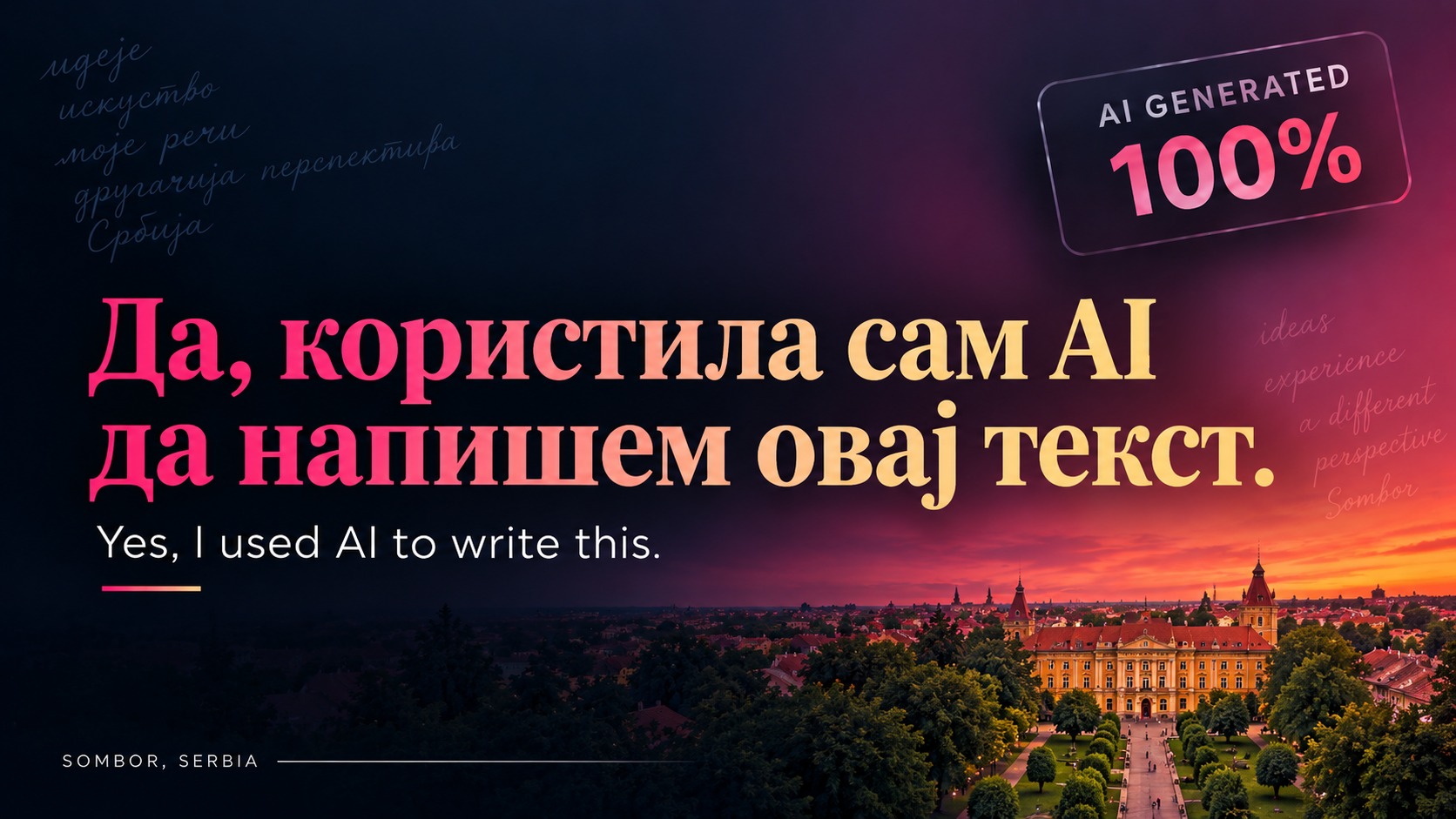
Yes, I used AI to write this article.
There. Now you don’t need an AI detector.
And yes, if you run this text through one, there is a good chance it will tell you that some percentage of it was AI-generated. Maybe a very high percentage.
I know, because that is exactly what happened to me a few days ago.
A journalist was looking for expert comments. I wrote my answer myself: my experience, my examples, things that actually happened to me. Then I got nervous and ran it through an AI detector. It said 100% AI. I rewrote parts of it and tried a different one. 100%. A third one, just to be sure. Still 100%.
Three pieces of software read my own life story and decided I had nothing to do with it.
That is why I wrote this article.
But before you decide what any of that says about this one, let me tell you how I actually write.
What an AI detector sees in a non-native writer
I live in Serbia. My native language is Serbian, and English is not even remotely the language in which my first thoughts appear in my head.
My English is good. I’ve studied it for years, I work in English every day, and I can write my own articles in English. But it will never be my native language. There will always be a phrase a native speaker would choose more naturally, an article I might miss, or a sentence that is technically correct but somehow doesn’t sound quite right.
For years, people like me simply had to accept that disadvantage.
And this isn’t really a Serbian problem. It’s a problem shared by everyone who uses English to communicate with the world without having been born into it. There are far more of us than there are native speakers: Ethnologue counts around 1.49 billion English speakers in the world, and only 372 million of them grew up with the language.
We come from different countries, speak completely different languages and have very different levels of English, but the disadvantage is essentially the same: what we know can easily be judged by how naturally we can express it in someone else’s language.
You could know your subject. You could have something original to say. You could spend days researching it. And then someone with exactly the same knowledge, or less, could sound more credible simply because they happened to be born speaking the language of the internet.
AI changed that for me.
Not because it suddenly started having my ideas for me.
Because it helps me express the ideas I already have.
Sometimes AI starts with my Serbian. Sometimes with my English.
There isn’t one single way I use AI when I write.
Sometimes I write something in Serbian because that is the fastest and most natural way for me to get a complicated thought out of my head. Then I ask AI to translate it.
Sometimes I write directly in English and ask it to polish what I’ve written.
Sometimes I give it my notes, my examples, my conclusions and a very detailed explanation of what I want to say, and we work from there.
And sometimes I hate what it gives me.
Actually, that happens quite often.
I delete sentences. I put my own sentences back. I tell it that something doesn’t sound like me. I remove words I would never use. I complain when it turns a personal story into corporate LinkedIn English. I ask it to stop making everything sound profound. Then I read the whole thing again and change more.
If you’ve ever worked with me on an article, you would probably laugh at the idea that I simply press a button and publish whatever comes out.
But an AI detector doesn’t know any of that.
It only sees the finished text.
Apparently, my English can now be *too good*
This becomes particularly strange when I write something for someone else.
I sometimes respond to journalists looking for expert comments. They ask about something I have actually experienced or something we have learned through our work. I give them my experience, my opinion and my examples.
These aren’t facts AI invented about my life. They happened to me.
These aren’t opinions ChatGPT decided I should have. They’re mine.
But I still find myself thinking about whether my answer sounds “too AI.”
Think about how absurd that is.
I am not worrying that what I wrote is false. I am not worrying that I can’t defend my argument. I am not worrying that I copied someone else’s work.
I’m worrying that my English sounds too polished.
So sometimes I deliberately change a perfectly good sentence because I know it has that familiar AI rhythm. I replace a word because it isn’t a word I would normally use. I make the text less polished so that another piece of software, or a human who has learned to look for certain patterns, won’t decide that I didn’t write my own thoughts.
We have somehow reached a point where a non-native English speaker can be suspicious because her English sounds too good.
I don’t think that’s progress.
What exactly are we trying to detect?
I understand why AI-generated content worries people.
I don’t want to read 2,000 words that nobody thought about, nobody checked and nobody really needed to publish either. I don’t want invented sources, fake expertise or fifty near-identical articles created just to catch search traffic.
I work with AI tools every day. I know exactly how much rubbish they can produce.
But “AI was used” and “a human didn’t create this” are not the same statement.
That’s the distinction we’re losing.
If I write 1,000 words in Serbian and AI translates them into English, is the English article AI-generated?
What if I write those same 1,000 words in English and AI fixes my grammar?
What if I ask it for ten alternatives for one sentence because I know what I mean but can’t find the English expression I’m looking for?
At exactly which prompt do my thoughts stop belonging to me?
And who gets to decide?
You probably don’t speak my language
Maybe you’ve heard of Serbia.
If nothing else, you’ve probably heard of Novak Djokovic or Nikola Jokic.
But do you speak Serbian?
Could you read this article if I wrote it in the language in which I can express every tiny nuance exactly as I want?
We even have our own Cyrillic alphabet alongside the Latin one:
Да, користила сам AI да напишем овај текст.
That’s the title of this article in Serbian.
If I continued like that, most of the people I want to reach would be gone by the second line.
That was always my problem to solve. The internet didn’t adapt to my language; I had to adapt to its dominant one.
For a long time, that meant accepting that my English version would never carry quite the same voice as the Serbian one.
Now I have a tool that can help close that gap.
And somehow I’m supposed to be embarrassed about using it.
I’m not.
The tool isn’t the author
We’ve always used tools to communicate better. Spellcheck catches my typos, Google helps me check information, WordPress publishes the result to the world.
AI is a much more powerful tool, obviously, and that power comes with new problems. We should absolutely care about hallucinations, misinformation, plagiarism, fake expertise and mass-produced garbage.
But those are problems with what people do with AI.
Simply detecting that AI touched a piece of text tells you almost nothing about how that text was created.
It certainly doesn’t tell you who had the idea.
It doesn’t tell you who did the research.
It doesn’t tell you whose experience you’re reading.
And it doesn’t tell you whether the person whose name is on the article read every sentence, checked it, changed it and is willing to stand behind it.
I am.
So yes, I used AI to write this
I could have tried to hide it.
I could have run this through three humanizers until an AI detector gave me a score I liked. I could have deliberately added mistakes. I could have rewritten perfectly good sentences just to prove to an algorithm that I am human.
But that would be ridiculous.
So here is the easier version.
Yes, I used AI.
Now forget the detector for a moment and read the article.
Do you understand what I wanted to say?
Was there an actual thought behind it?
Did I give you something worth thinking about?
Do I stand behind what I published?
Those are much more interesting questions.
AI didn’t give me a voice. I already had one.
It gave my voice a better translator, editor and language assistant.
And for someone sitting in Sombor, Serbia, writing for people thousands of kilometres away who will probably never learn a word of Serbian, that’s a pretty remarkable tool to have.
So yes, I used AI to write this.
Now tell me what you think about what I said.