A pair of Luma AI glasses costs less than dinner for two. The catch is that nobody will tell you who makes them.
Luma AI glasses broke into Google Trends this month, and the searches are a mess. Some people hunt for a $55 pair with a camera, tinting lenses and an assistant you wake by saying “Hi Luma.” Others land on $599 display glasses from VITURE. A few end up at an AI video startup being sued by Carl Sagan’s estate. None of those products are related, and only one of them is what the trend is actually about.
What Are the Luma AI Glasses Everyone Is Searching For?
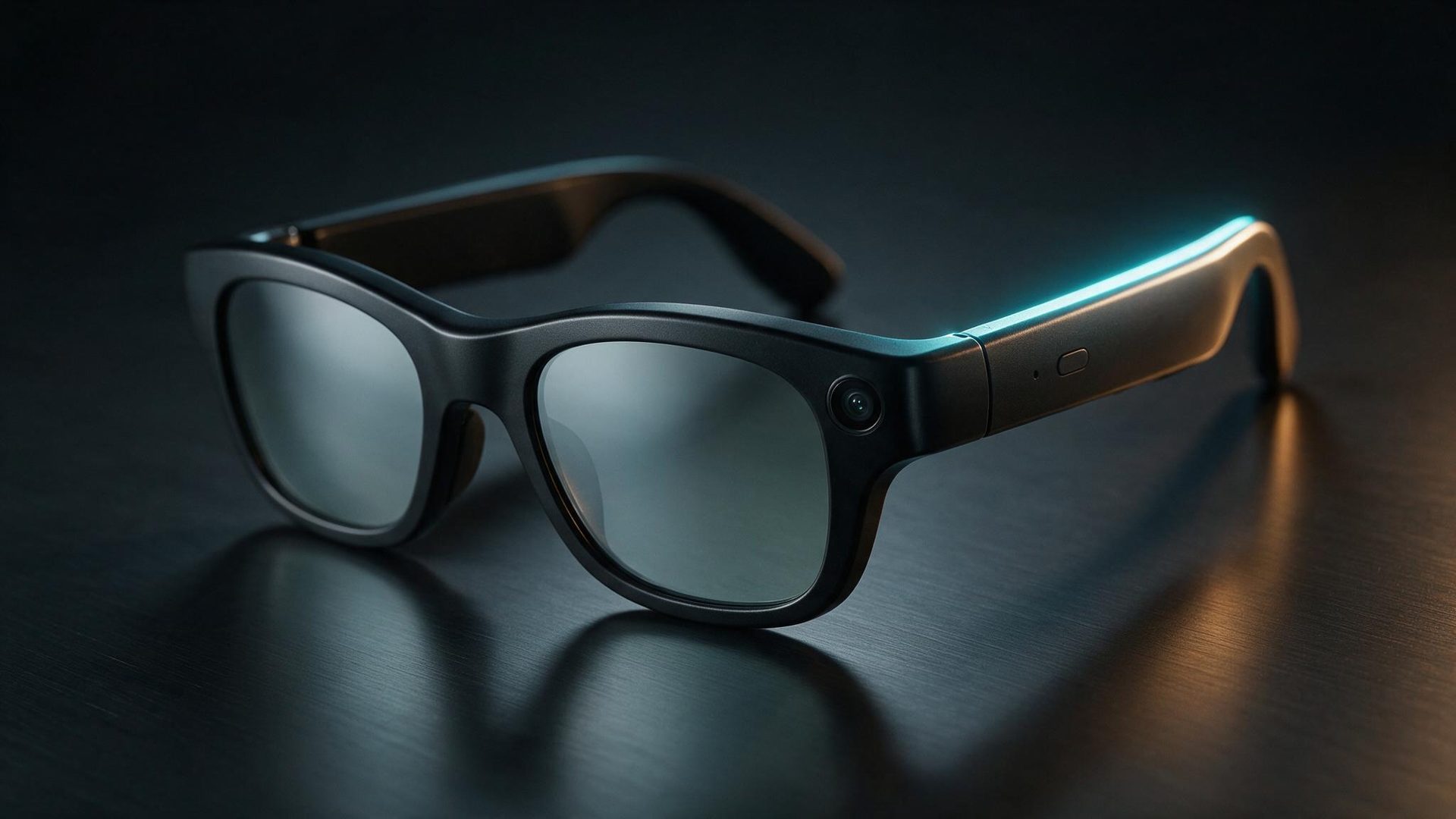
First, start with the pair that is driving the trend. Sellers list it as the Luma All-in-One AI Electrochromic Smart Glasses, and in photos these Luma AI sunglasses look like a chunky set of black wayfarers. A small camera sits in the right hinge, the lenses darken on command, and a voice assistant answers when you talk to it.
Most of that traffic lands on a listing at KYD’s Choice, an online store asking $54.98, down from $69.98. At the time of writing, that page shows the glasses as sold out. However, the identical product is easy to find elsewhere, and that is where the story gets interesting.
Similarly, Google Trends tells the same story from another angle. Shoppers also type shorter forms like Luma All-in-One glasses, Luma All-in-One AI glasses, “hi luma,” and AliExpress. In other words, plenty of buyers already suspect they are looking at the same box with different labels.
Inside the Luma All-in-One AI Electrochromic Smart Glasses
At first glance, the spec sheet is specific enough to be useful. An 8MP camera records 1080p video at 30 frames per second, and 8GB of onboard storage keeps the footage on the glasses. In addition, the Luma AI smart glasses offer four levels of tint. These Luma AI electrochromic smart glasses switch shade instantly when you tap the front of the left temple.
Furthermore, battery claims land at roughly 10 hours of music, 10 hours of talk time and 120 hours of standby from a 300mAh cell. Open-ear speakers and microphones handle calls, dual-band Wi-Fi 4 moves files across, and the glasses keep running while they charge.
On paper, that is a serious feature list for $55 Luma all in one AI glasses. The trouble is that a spec sheet is a promise, not a measurement, and no independent reviewer has yet checked a single number on it.
Hi Luma: What the Assistant on the Luma AI Glasses Actually Does
Say “Hi Luma” and the assistant wakes, which is why plenty of shoppers search for them as Hi Luma glasses. Others guess the phrase and look for Hey Luma glasses instead. From there it answers questions, holds a short conversation, identifies whatever the camera is pointed at, and translates speech. You can also tell it to take a photo, start a recording, skip a track or pick up a call.
Notably, no listing says which model powers any of that. There is no published privacy policy for the voice data, no named cloud provider, and no firmware update schedule. Because of this, the assistant is the part of the Luma AI glasses that deserves the hardest look.
Naturally, camera glasses raise the stakes further. A device that films other people and streams audio to an unnamed server is a different proposition from a cheap Bluetooth speaker, however similar the price tag looks.
Four Very Different Products Share the Luma Name
Search interest for Luma jumped across several products at once, and they have nothing to do with each other. Here is what sits behind each name.
Every product called Luma, side by side
| Product | What it actually is | Price |
|---|---|---|
| Luma All-in-One AI Electrochromic Smart Glasses | Unbranded camera sunglasses, 8MP, Hi Luma assistant | $54.98 at KYD’s Choice |
| AI Smart Glasses at vaxapack | The same spec sheet and the same assistant, sold with no brand name | Store price, ships in 5 to 15 days |
| Luma Glasses at lumaglasses.us | Translation glasses from UAB Rara Digital, no camera | $65.45 promo, $249.98 list |
| VITURE Luma | 1200p micro-OLED display glasses with electrochromic film | $399 |
| VITURE Luma Pro | Same display, myopia adjustment to -4.0D | $499 |
| VITURE Luma Ultra | Same display, myopia adjustment to -6.0D | $599 |
| Luma AI (Luma Labs) | An AI video model, Dream Machine and Ray3. Not eyewear | n/a, software |
As a result, a shopper who reads a glowing writeup of one often buys a completely different device. The VITURE hardware is a display, the $55 pair is a camera, the Lithuanian listing is a translator, and Luma AI has never made eyewear at all.

VITURE Luma Pro and Luma Ultra Are Something Else Entirely
VITURE is a real company with real reviews, and its Luma line has nothing to do with $55 sunglasses. Instead, these are wearable displays. You plug them into a phone, console or laptop, and a 1200p micro-OLED panel puts a large virtual screen in front of your eyes.
Pricing runs $399 for the Luma, $499 for the Luma Pro and $599 for the Luma Ultra, with myopia adjustment up to -6.0D on the top model. Tom’s Guide ran the Luma Pro through a full hands-on review, which is exactly the scrutiny the cheap pair has never faced.
Meanwhile, VITURE runs a referral program rather than a public affiliate one, and it publishes prices, specs and support terms openly. That transparency is the real difference between the two kinds of Luma. The link below is our referral, and it takes $50 off your first VITURE order.
Luma AI Glasses vs Ray-Ban Meta and the Best AI Glasses 2026
To begin with, the Luma AI glasses price is the only category the cheap pair wins outright. Ray-Ban Meta Gen 2 starts at $379, Oakley Meta HSTN at $399, and Xiaomi AI Glasses land near $280 as an import. Against those numbers, $55 looks unbeatable until you ask what the extra money actually buys.
Mostly, it buys accountability. Named brands publish privacy policies, ship firmware updates, honor warranties and get pulled apart by reviewers who owe them nothing. Our roundup of the best AI smart glasses ranks the models that clear that bar.
By contrast, the Luma AI glasses clear none of it. That does not automatically make them junk, but it does mean you are buying on faith rather than on evidence.
The Luma Smart Glasses App and What You Are Really Buying
Meanwhile, several functions need a phone, which is where the Luma smart glasses app comes in. No listing names its developer, links to a store page, or says how long it will be maintained. For hardware that records video and listens for a wake word, that is a serious gap.
Ultimately, you are buying a factory order rather than a brand. The same glasses turn up on AliExpress and on Amazon under house names such as AMZISH, and every shop writes its own product copy. Therefore support, returns and firmware all depend on which store you happened to click.
If you go ahead anyway, buy through a marketplace with a real returns process, pay by a method you can dispute, and treat the battery and privacy claims as unverified until somebody tests them.

Still tempted by the $55 pair? Buy it where returns are real and the payment is easy to dispute.
Want More on Luma AI Glasses?
If the $55 pair has lost its shine, look at a device somebody stands behind. Our Ray-Ban Meta Gen 2 review explains why it is still the default pick, and the Xiaomi AI Glasses review covers the only other model on our list with electrochromic lenses.
Frequently Asked Questions
What are the Luma AI glasses?
They are camera sunglasses sold as the Luma All-in-One AI Electrochromic Smart Glasses. An 8MP camera, 8GB of storage, four levels of lens tint and a Hi Luma voice assistant sit in a frame that costs about $55.
Who makes the Luma smart glasses?
No manufacturer is named anywhere. Identical glasses appear on KYD’s Choice, vaxapack, AliExpress and Amazon under house brands, which means this is a white label product that each shop simply renames.
How much do the Luma AI glasses cost?
Pricing sits at $54.98 on KYD’s Choice, marked down from $69.98, and that listing currently shows as sold out. Other stores selling the same hardware set their own prices, shipping times and return terms.
What does Hi Luma do?
Saying Hi Luma wakes the built-in assistant. It answers questions, describes what the camera sees, translates speech, and triggers photos, video, audio recording, music controls and calls without your phone.
Are VITURE Luma and the Luma AI glasses the same thing?
Absolutely not. VITURE Luma, Luma Pro and Luma Ultra are wearable displays priced from $399 to $599. They plug into a device and project a virtual screen, and none of them carries a camera.
Are the Luma smart glasses worth buying?
Only if you accept the risk. So far, nobody has independently tested them, the app names no developer, and warranty support depends on the shop. Established AI glasses cost more but come with real accountability.
Sources
*Sources: KYD’s Choice, vaxapack, VITURE, Luma Glasses, Forbes, best-ai.news.* *Images: editorial illustrations, not photographs of the product.*