
Two AI labs, one 27-year-old assumption, and the same answer on the same day. This is how AI impacts theoretical computer science now.
The clearest example of how AI impacts theoretical computer science arrived this week. On October 26, 2026, OpenAI said an internal model had disproved the Exponential Time Hypothesis. Within hours, Anthropic posted its own disproof, credited to Claude. Neither claim has passed independent review yet. Still, researchers are already asking which of their own results survive.
What Is the Exponential Time Hypothesis?
The Exponential Time Hypothesis, or ETH, is a bet about a famous hard problem called 3-SAT. In 3-SAT, you get a logical formula and ask whether any true or false setting of its variables makes it true.
Russell Impagliazzo, Ramamohan Paturi and Francis Zane proposed ETH in the late 1990s. It says no algorithm can solve 3-SAT meaningfully faster than exponential time in the number of variables. In other words, every extra variable keeps multiplying the work.
Nobody ever proved it. However, researchers trusted it enough to build on it. A typical paper says that problem X is hard, assuming ETH is true.
Exponential Time Hypothesis OpenAI: The Claim
OpenAI announced three results on October 26, spanning mathematics, computer science and physics. The computer science result is the one that shook the field. According to TNW, the model found the disproof on October 16 and OpenAI checked it in Lean the next day.
Lean is a proof assistant that verifies every logical step by machine. OpenAI then posted the write-up and the Lean proof on GitHub. The core of the claim is a deterministic algorithm that solves 3-SAT in subexponential time.
The same announcement covered the local smoothing conjecture and a proof that certain quantum field theories exist in four dimensions. Earlier this month, the company had already dropped hundreds of papers in its Open AI math release.

Anthropic Claims an Exponential Time Hypothesis Disproof Too
Anthropic did not wait long. Researcher Levent Alpöge shared a paper titled “A 2^o(n) Time Algorithm for 3-SAT”, with the author listed as Claude, Anthropic. OfficeChai reports that an internal Claude model found the core algorithm on October 16, the same date as OpenAI.
Alpöge said the discovery used about 14 million output tokens and no human input. Afterwards, researchers worked with Claude on how the paper reads. The Lean 4 version spans 1,050 modules built on Mathlib.
There is a catch, though. The appendix admits the Lean code was written by AI models and reviewed by other instances of the same models. At publication, no person was known to have checked it.
How AI Impacts Theoretical Computer Science Research
Here is where the story gets personal for researchers. Claude’s own literature search, cited in the paper, found more than 800 papers that depend on ETH or related hypotheses. If the disproof holds, those conditional hardness results lose their footing.
That does not make them wrong overnight. Instead, each one needs a new justification or a weaker statement. On the other hand, the result also implies faster theoretical algorithms for Independent Set, Clique, Vertex Cover and Dominating Set.
Two rival labs reaching the same result independently is new, too. As a result, the hard part of research is shifting. Generating a proof is getting cheaper, while checking and explaining it remains slow human work.
The Exponential Time Hypothesis Is False? Not So Fast
OpenAI did not ask the field to take its word for it. Impagliazzo and Paturi of UC San Diego, two of the people who proposed ETH, now lead the review with Ryan Williams of MIT. They signed no non-disclosure agreements and are not being paid.
Their statement is careful: “Our involvement should not be taken as certification of the claim.” The group also asked OpenAI to release all raw data and fund a conference, and OpenAI agreed.
Scientific American describes experts as still staggering at the releases. Some mathematicians call them slop drops, and an expert panel has criticised how OpenAI publishes such results.
AI Impacts Theoretical Computer Science, Not P vs NP
The strong exponential time hypothesis, or SETH, is a stricter version of the same idea. Because SETH implies ETH, a disproof of ETH knocks out SETH as well. Anthropic’s paper says so explicitly.
P vs NP is a different matter. Both labs stress that their results do not bring it closer to an answer. SAT stays hard in practice, and the new bound is purely asymptotic.
How asymptotic? According to OfficeChai, Claude’s bound only beats brute force once a formula has roughly 10^10,000 variables. So chip verification and scheduling tools will not get faster this year.
AI Impacts Theoretical Computer Science: OpenAI vs Anthropic
The two announcements overlap in timing but differ in how they were checked. Here is what each lab has published so far, based on the reports cited below.
| Detail | OpenAI | Anthropic |
|---|---|---|
| Disproof found | October 16, 2026 | October 16, 2026 |
| Announced | October 26, 2026 | Hours later, same day |
| Credited to | Internal OpenAI model | Claude, Anthropic |
| Machine check | Lean proof on GitHub | Lean 4, 1,050 modules |
| Human review | Impagliazzo, Paturi, Williams | None known at publication |
| Extra commitment | Conference funding | n/a |
OpenAI also gave $5 million to the Simons Foundation for workshops on AI-produced results. Meanwhile, Anthropic’s model has done this before. Last month Claude delivered a Lean proof when AI solves a percolation theory problem.
Want More on AI Impacts Theoretical Computer Science?
If you read papers for a living, AI can already save you hours on literature reviews and citations. Start with our guide to the best AI research tools and pick the one that fits your field.
Frequently Asked Questions
What is the Exponential Time Hypothesis?
It is a 1990s conjecture by Impagliazzo, Paturi and Zane. It says 3-SAT cannot be solved in subexponential time, so the work grows exponentially with the number of variables.
Did OpenAI disprove the Exponential Time Hypothesis?
OpenAI claims it did. On October 26, 2026, it said an internal model found a subexponential 3-SAT algorithm, checked in Lean. Independent experts are still reviewing the proof.
Did Anthropic also disprove ETH?
Yes, Anthropic posted its own claim hours later. Its paper credits Claude and includes a Lean 4 formalization, although no person had checked that Lean code at publication.
Is the ETH disproof verified?
Not yet. Russell Impagliazzo, Ramamohan Paturi and Ryan Williams lead a review of the OpenAI claim. They say their involvement is not a certification of the result.
Does this solve P vs NP?
No. Both labs say P vs NP stays open. In addition, the new algorithm is purely asymptotic and offers no practical speedup for real SAT solvers.
How does AI impact theoretical computer science now?
AI now produces proofs that challenge basic assumptions. Anthropic counted over 800 papers that rely on ETH, so checking and explaining results is becoming the main human job.
Sources
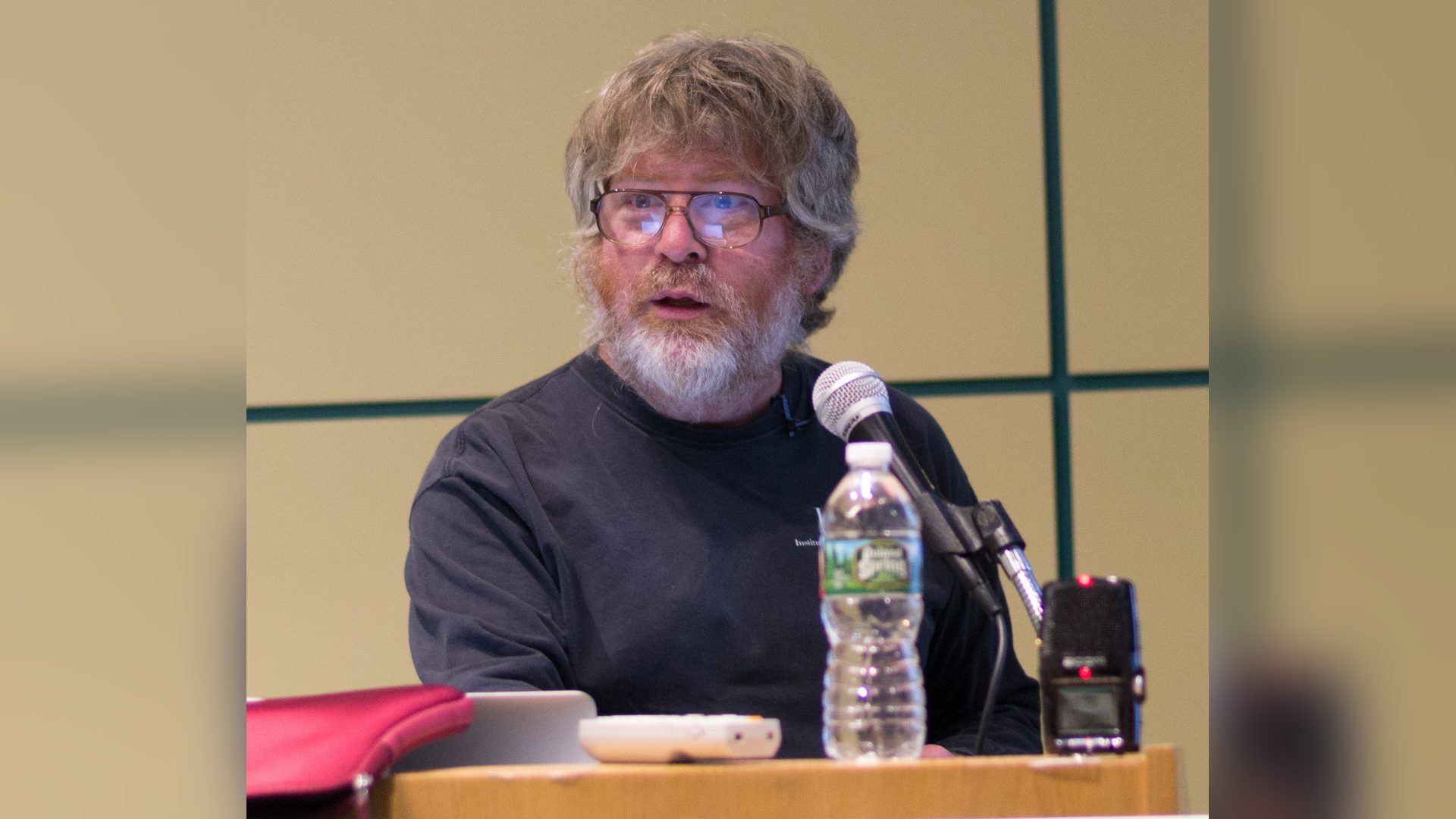
Scientific American, TNW, OfficeChai (ETH explainer), OfficeChai (Anthropic), RuntimeWire. *Photos: Russell Impagliazzo at the DIMACS Workshop on Cryptography by BöhmMartin, CC BY-SA 4.0, resized and placed on a blurred background; 1515 Third Street (OpenAI headquarters in San Francisco) by Coolcaesar, CC BY 4.0, cropped and resized.*