Disclosure: this article contains affiliate links. If you buy through them, we may earn a commission at no extra cost to you. It never decides our picks. Affiliate Disclosure · How we use AI
The cheapest ticket into Neo QLED: our Samsung QN70F review finds out what the entry price really buys.
What Is the Samsung Neo QLED QN70F?
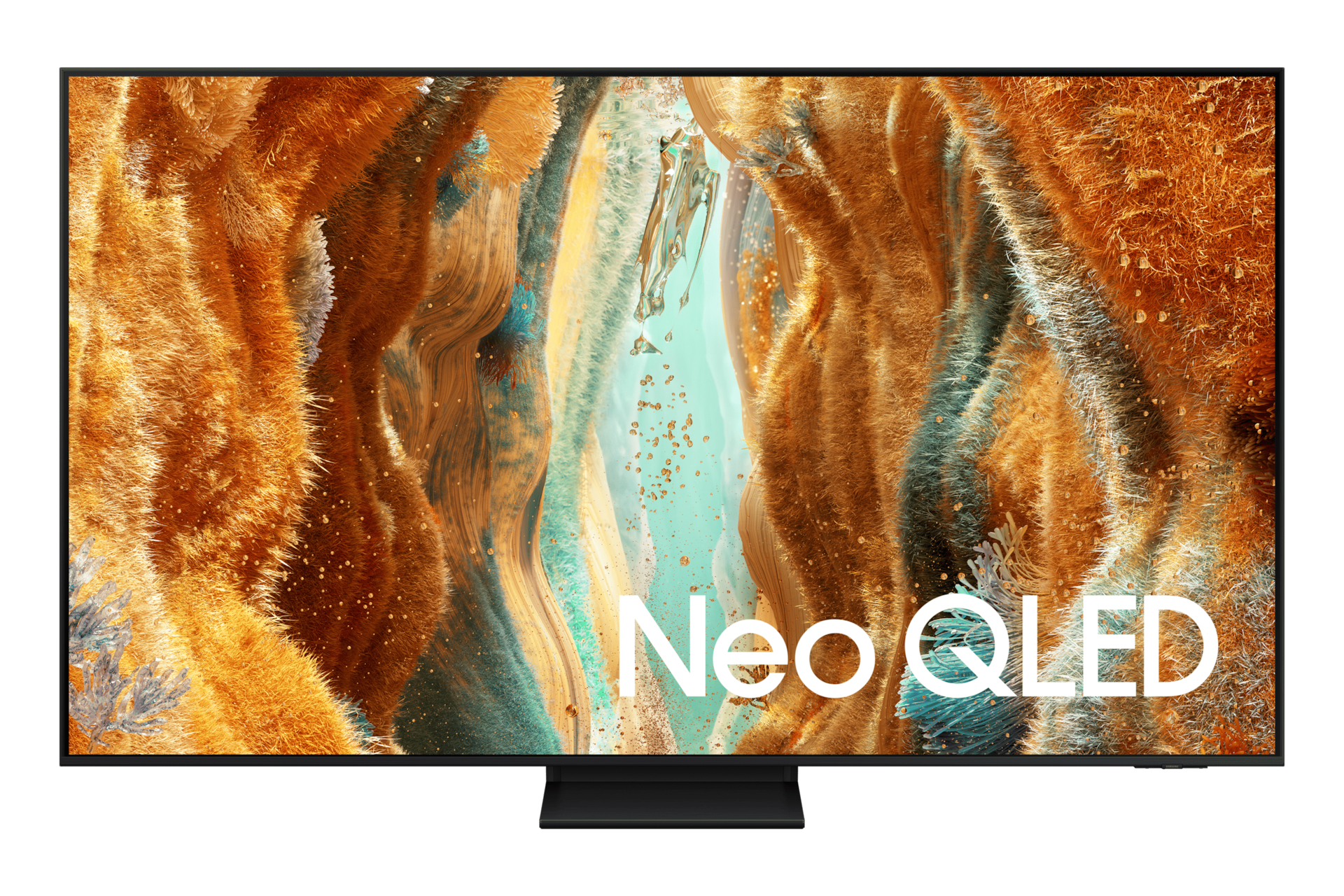
This Samsung QN70F review covers the Samsung QN70F, the gateway to Samsung’s 2025 Neo QLED family. It is the least expensive model with a mini-LED backlight, quantum-dot color and the same NQ4 AI Gen2 processor and Vision AI features as its pricier siblings. Its 2026 successor, the QN70H, has arrived, and (spoiler) it is a step down in several places, which makes the outgoing QN70F more interesting, not less.
On paper that is a tempting equation: flagship software, mini-LED hardware, mid-range price. Sizes run from 55 to 85 inches, starting around $899.
This Samsung QN70F review separates what genuinely carries over from the premium models, and where the savings show. Updated September 2026 with the measured brightness in nits, the edge-lit dimming question, current prices, and how it stacks up against the new QN70H.
Samsung QN70F Price and Where to Buy
Samsung’s own list prices, as of September 2026, are $899.99 (55-inch), $1,199.99 (65-inch), $1,599.99 (75-inch) and $2,299.99 (85-inch). Almost nobody pays that. Tom’s Guide bought its 65-inch for $899 in April 2026, Newegg listed the 75-inch at $997.99 in September 2026, and the 55-inch has dipped as low as $598 on Amazon according to price trackers.
One caveat that did not exist when this Samsung QN70F review was first written: the QN70F is now the outgoing model. Samsung.com showed every size as out of stock in late September 2026, so the Amazon, Best Buy and warehouse-club listings are where the remaining stock (and the best prices) live. At those street prices the value math gets interesting, though so does the competition from aggressive mini-LED rivals like TCL and Hisense, which is exactly the comparison to keep in mind below.
The US model codes, if you are cross-shopping listings: QN55QN70FAFXZA, QN65QN70FAFXZA, QN75QN70FAFXZA and QN85QN70FAFXZA. The four letters after QN70F vary by retailer and region and do not change the hardware.
Picture Quality: Honest Mini-LED, Honest Limits
Tom’s Guide measured the Samsung QN70F at 625 nits of peak HDR brightness in Filmmaker mode and 733 nits in SDR Standard mode. Real HDR scenes land nearer 500 nits in most content. That is acceptable for the price: HDR highlights have some presence, colors are quantum-dot vivid, and Standard-mode brightness keeps daytime sports and news lively.
However, the limits are real. Blooming around bright objects on dark backgrounds is noticeable (subtitles glow slightly), and contrast trails both the QN80F and same-price rivals with denser backlights. As with all Samsungs, Dolby Vision is absent (HDR10+ instead), which stings on Netflix and Apple TV+. In short, a likeable picture with visible compromises.
Samsung QN70F Brightness: How Many Nits?
So, how bright is the Samsung QN70F in nits? The short answer is about 625 nits of peak HDR brightness on a 10% window in Filmmaker mode, 733 nits in SDR Standard mode, and roughly 500 nits in typical HDR scenes. Those are Tom’s Guide’s April 2026 lab numbers, and the European lab at choose.tv landed in the same place with a 619-nit peak and around 500 nits in most test scenes. Those are the figures this Samsung QN70F review now uses throughout.
For context, the QN80F reaches roughly 1,100 nits, the QN90F goes well past 2,000, and the Hisense U75QG that Tom’s Guide tested alongside the QN70F hit 2,222 nits. So the QN70F is the dimmest TV in its price bracket for HDR, while its SDR brightness is genuinely strong. RTINGS puts the exact figures behind its membership wall, but its verdict text says the same thing: excellent peak brightness in SDR, and bright enough for a moderately lit room.
Is the Samsung QN70F Edge-Lit? The Dimming Zone Question
Yes. The Samsung QN70F is an edge-lit mini-LED TV, not a full-array one. Tom’s Guide attributes its lackluster HDR to the “Mini-LED edge-lit screen,” and choose.tv counted 20 dimming zones arranged in a single row. That is why bright objects bloom across dark backgrounds and why RTINGS calls the local dimming feature “incredibly ineffective.”
Samsung does not publish zone counts, and the warehouse-club QN70FD variant is advertised with “Ultimate UHD Dimming” instead of “Supreme UHD Dimming,” which suggests more zones. RTINGS does not expect that to change contrast meaningfully. If dimming precision is your priority, the QN80F, a TCL QM7K or a Hisense U7 series set gives you a full-array backlight for similar money. That trade-off is the one this Samsung QN70F review keeps coming back to.
Vision AI and the NQ4 AI Gen2 Processor
Here is where the QN70F punches up. It runs the same NQ4 AI Gen2 chip as the QN80F, so 4K AI upscaling is genuinely good (HD streams look crisp), and the full Vision AI suite is aboard: Click-to-Search for on-screen lookups, Live Translate for real-time subtitles, and an AI mode that tunes picture and sound scene by scene.
As a short NQ4 AI Gen2 processor review in its own right: the chip is the same silicon Samsung uses up to the QN90F, so upscaling, motion processing and the Tizen interface behave identically across the 2025 Neo QLED range. The 2026 QN70H drops back to the plain NQ4 AI processor, which is one of the reasons this Samsung QN70F review still recommends the older set.
The TV also acts as a SmartThings hub with Bixby and Alexa built in. Software-wise, nothing about this TV feels entry-level.
Gaming Performance: The Sleeper Strength
Gamers get the headline value. Input lag measures just 9.8ms (and about 8ms at 120Hz), which is effectively flagship response, with a 120Hz native panel boostable to 144Hz, FreeSync Premium Pro, ALLM and four full HDMI 2.1 ports.
Add Samsung’s Gaming Hub for cloud titles and the QN70F quietly becomes one of the cheapest ways to drive a PS5 or Series X properly. For a competitive player on a budget, that 8 to 10ms response matters more than peak nits.
Sound, Tizen and Everyday Use
Audio is serviceable: clear dialogue, modest bass, with Q-Symphony available if you add a Samsung soundbar. Tizen runs every major app plus 2,700+ free Samsung TV Plus channels, and the interface is the same quick, clean experience as on the flagships.
Setup is simple, the remote is solar-charged, and day-to-day the QN70F feels like a more expensive TV, until a dark movie scene reminds you of the backlight class.
QN70F vs QN80F: Where the Extra Money Goes
The QN80F buys you roughly 500 more peak nits (about 1,100 vs 625), much higher full-screen brightness (around 869 nits), a full-array backlight and finer dimming control. That means meaningfully better HDR movies and daytime punch. The QN70F keeps the same processor, Vision AI, gaming response and platform.
Therefore the decision is honest: if your viewing is mostly bright-room TV, sports and gaming, the QN70F’s savings are rational. If HDR films matter weekly, the QN80F (or an OLED, see our LG C5 review) is worth the stretch.
Samsung QN70F vs QN70H (2026): Should You Wait for the New One?
Samsung replaced the QN70F with the QN70H in 2026, and this is the rare case where the newer model is the worse TV. The QN70H moves to the plain NQ4 AI processor, a native 60Hz panel, three HDMI 2.0 ports capped at 4K 60Hz, and no VRR or FreeSync support. RTINGS describes it as an edge-lit set that is “light on gaming features,” with a very slow response time and sub-par brightness that struggles in bright rooms.
The QN70F, by contrast, keeps the NQ4 AI Gen2 chip, the 120Hz panel boostable to 144Hz, four HDMI 2.1 inputs, FreeSync Premium Pro and Gaming Hub. The QN70H’s only real advantages are two smaller sizes (43 and 50 inches) and a longer software-update runway, since Samsung’s seven-year clock starts a year later. Launch pricing for the QN70H runs from $549.99 for the 43-inch to $2,299 for the 85-inch, which is not cheaper than the QN70F’s current street prices.
- Processor: QN70F NQ4 AI Gen2 vs QN70H NQ4 AI
- Refresh rate: QN70F 120Hz native, 144Hz boost vs QN70H 60Hz native
- HDMI: QN70F 4x HDMI 2.1 (4K 144Hz) vs QN70H 3x HDMI 2.0 (4K 60Hz)
- VRR / FreeSync: QN70F yes vs QN70H no
- Sizes: QN70F 55 to 85 inches vs QN70H 43 to 85 inches
- Backlight: both edge-lit mini-LED
Our advice in this Samsung QN70F review is simple: if you can still find a QN70F in your size at street price, buy it over the QN70H. Gamers in particular lose a lot in the 2026 model. Movie-first buyers should skip both and look at the QN80F or a full-array TCL or Hisense.
Real-World Viewing: Day Shift Star, Night Shift Adequate
Daily life with the QN70F splits neatly in two. Daytime, it is a happy TV: sports, news and sitcoms look bright and colorful, quantum-dot saturation flatters everything, and the AI upscaling makes cable look better than it deserves.
After dark, expectations need managing. Real-content HDR around 500 nits means highlights gesture at spectacle rather than delivering it, and bright-on-black scenes (credits, subtitles, starfields) show the blooming reviewers flag. None of it is disqualifying at the price; all of it is visible to a critical eye.
Where it never disappoints is responsiveness: menus, apps and especially games feel immediate. That 9.8ms figure translates into a TV that simply never feels laggy.
Setup Tips That Matter
Use Movie or Filmmaker mode for films (Standard runs cool and bright), leave Intelligent Mode on for everyday mixed viewing, and let Game Mode auto-engage for consoles. Motion smoothing defaults are aggressive, so calm them under Picture Clarity for cinema nights.
One placement note: like its QN80F sibling, the screen is glossy, so avoid facing strong windows. And claim the free Samsung TV Plus channels during setup. On a budget set they meaningfully extend the content library at zero cost.
Samsung QN70F Specs at a Glance
The essentials:
- Panel: 4K VA LCD, edge-lit mini-LED backlight (about 20 dimming zones), quantum-dot color
- Processor: NQ4 AI Gen2 with 4K AI Upscaling
- Measured: 625 nits peak HDR (10% window, Filmmaker), 733 nits SDR Standard, ~500 nits in real HDR content
- HDR: HDR10+, HDR10, HLG (no Dolby Vision)
- Gaming: 120Hz (to 144Hz), 4x HDMI 2.1, FreeSync Premium Pro, ~9.8ms lag
- Platform: Tizen, Vision AI, SmartThings hub, Bixby + Alexa
- Sizes: 55, 65, 75, 85 inches (QN55QN70FAFXZA, QN65QN70FAFXZA, QN75QN70FAFXZA, QN85QN70FAFXZA)
- Released: spring 2025 (Samsung’s 2025 lineup); succeeded by the QN70H in 2026
What RTINGS and Tom’s Guide Say About the Samsung QN70F
Searching for the RTINGS Samsung QN70F review or the Tom’s Guide Samsung QN70F review? Here is what both labs found, in one place, so this Samsung QN70F review does not ask you to take our word alone. (If you searched for a Samsung QN70F test rather than a review, this is the section: these are lab measurements, not impressions.)
RTINGS bought the 55-inch and updated its test bench on September 18, 2026. Its verdict: “an okay TV overall” that looks best in a moderately lit room, with excellent SDR peak brightness and a local dimming feature it calls incredibly ineffective. It flags mirror-like direct reflections, blurry fast motion, a laggy interface on startup, and praises the VRR support and HDMI 2.1 bandwidth. The numeric scores sit behind RTINGS’ membership, so we do not quote them.
Tom’s Guide (Sean Captain, April 8, 2026) tested the 65-inch at $899 and called it “a very average QLED.” The measurements: 625 nits HDR peak in Filmmaker mode, 733 nits SDR in Standard, 9.8ms input lag, Rec. 709 coverage of 99.46%, UHDA-P3 coverage of 95.53%, and a Delta-E of 3.48, which is poor color accuracy out of the box. Its pros are the low input lag, high refresh rate and Standard-mode brightness; its cons are lackluster HDR, no Dolby Vision, a very dim Filmmaker mode and that color accuracy. It suggests auditioning the Hisense U65QF and TCL QM7K first.
Where we differ: both labs judge the QN70F as a movie TV, and as a movie TV it is average. Judged as a bright-room gaming TV at a 2026 street price, with the QN70H as its replacement, it holds up better than either verdict suggests.
QN70F vs QN70FD vs QN77F vs Q70F: Which Name Is Which?
The model soup around this TV causes real confusion, so here is the decoder. The QN70FD is the same TV sold through Costco and Sam’s Club, with a slightly different dimming label and no performance difference, per RTINGS. Over in Europe, the QN74F and QN77F are retailer derivatives of the QN70F (a QE65QN77F is a 65-inch QN70F under a different badge), which is why choose.tv reviewed the three names as one product. The Samsung Q70F is a different, cheaper TV entirely: standard QLED with no mini-LED backlight, so a Q70F review is not a Samsung QN70F review and will not tell you anything about this set.
How Samsung Neo QLED QN70F Compares
Pros and Cons
What we liked
- Cheapest entry to Neo QLED mini-LED
- Same NQ4 AI Gen2 + full Vision AI as pricier models
- Excellent gaming: ~9.8ms lag, 144Hz, 4x HDMI 2.1
- Crisp 4K AI upscaling of HD content
- Fast, complete Tizen platform with free TV Plus channels
What could be better
- Real-content HDR brightness around 500 nits (625 peak)
- Edge-lit backlight with visible blooming on dark scenes
- No Dolby Vision (HDR10+ only)
- TCL/Hisense rivals offer stronger backlights for similar money
Who Should Buy the Samsung QN70F?
Budget-conscious gamers and bright-room households who want Samsung’s 2025 software experience (Vision AI, Tizen, SmartThings) with mini-LED color at the lowest cost of entry. The gaming response alone justifies it for console players.
Movie-first viewers should weigh the QN80F’s brighter HDR or an OLED, and spec-hunters should cross-shop TCL and Hisense mini-LEDs before committing.
Final Verdict: Is the Samsung QN70F Worth It?
So, is the Samsung QN70F worth it? Yes, if you game or watch in a bright room, and you can still find one at 2026 street prices. The Samsung QN70F is a likeable, software-rich entry into Neo QLED with one genuinely elite trait (its gaming response) and one honest weakness (HDR punch from an edge-lit backlight). Buy it for the smart features, the upscaling and the 9.8ms input lag. Skip it if cinematic HDR is the priority, and do not trade it for the 2026 QN70H.
Want More After This Samsung QN70F Review?
See the whole field ranked in our roundup of the best AI smart TVs, read the step-up in our Samsung QN80F review, or compare against OLED in our LG C5 review.
Frequently Asked Questions
Is the Samsung QN70F worth it?
Yes for gamers and bright-room TV on a budget. The Samsung QN70F shares the NQ4 AI Gen2 processor and Vision AI with pricier Neo QLEDs and adds a 9.8ms input lag. HDR-movie fans should consider the brighter, full-array QN80F instead.
How bright is the Samsung QN70F?
The Samsung QN70F measures 625 nits peak HDR in Filmmaker mode and 733 nits SDR in Standard mode per Tom’s Guide, with roughly 500 nits in real HDR scenes. That is acceptable for the price but well below the QN80F (about 1,100 nits) and QN90F.
Does the Samsung QN70F support Dolby Vision?
No. The Samsung QN70F supports HDR10+, HDR10 and HLG. Like all Samsung TVs it omits Dolby Vision.
Is the Samsung QN70F good for gaming?
Excellent. The Samsung QN70F has about 9.8ms input lag (around 8ms at 120Hz), a 120Hz panel boostable to 144Hz, FreeSync Premium Pro and four HDMI 2.1 ports, which is flagship-grade response at an entry price.
Samsung QN70F vs QN80F: what is the difference?
The QN80F adds roughly 500 peak nits over the Samsung QN70F, far higher full-screen brightness, a full-array backlight and better dimming control for a few hundred dollars more. Processor, Vision AI, gaming and platform are essentially the same.
Does the Samsung QN70F have Vision AI?
Yes. The Samsung QN70F runs the full 2025 Vision AI suite: Click-to-Search, Live Translate and AI picture/sound optimization, plus SmartThings hub duties with Bixby and Alexa.
What sizes does the Samsung QN70F come in?
The Samsung QN70F comes in 55, 65, 75 and 85 inches (model codes QN55QN70FAFXZA through QN85QN70FAFXZA). Its 2026 successor, the QN70H, adds 43 and 50-inch sizes.
How many nits is the Samsung QN70F?
About 625 nits of peak HDR brightness (10% window, Filmmaker mode) and 733 nits in SDR Standard mode, per Tom’s Guide. In most real HDR scenes the Samsung QN70F sits around 500 nits.
Is the Samsung QN70F edge-lit or full array?
Edge-lit. The Samsung QN70F uses an edge-lit mini-LED backlight rather than a full array behind the panel, which is why its local dimming and blooming control trail the full-array QN80F and rivals from TCL and Hisense.
How many dimming zones does the Samsung QN70F have?
Samsung does not publish the number. The choose.tv lab counted 20 dimming zones in a single row on the Samsung QN70F, and RTINGS rates its local dimming as incredibly ineffective. Meanwhile, the QN70FD warehouse variant is labeled Ultimate UHD Dimming and may have more zones, without a meaningful contrast gain.
What is the difference between the Samsung QN70F and QN70FD?
The QN70FD is the Samsung QN70F as sold at Costco and Sam’s Club. RTINGS notes it is advertised with Ultimate UHD Dimming instead of Supreme UHD Dimming, but expects no meaningful difference in performance.
Is the Samsung Q70F the same as the QN70F?
No. The Q70F is a standard QLED without a mini-LED backlight and without the NQ4 AI Gen2 processor. The Samsung QN70F is the Neo QLED (mini-LED) model, one tier up.
Samsung QN70F vs QN70H: which should I buy?
The Samsung QN70F, if you can still find it. Samsung’s 2026 QN70H drops to a 60Hz panel, three HDMI 2.0 ports, no VRR and the older NQ4 AI processor. By contrast, the QN70F keeps 144Hz, four HDMI 2.1 ports, FreeSync Premium Pro and the NQ4 AI Gen2 chip.
When was the Samsung QN70F released?
The Samsung QN70F is part of Samsung’s 2025 Neo QLED lineup and went on sale in spring 2025. Its replacement, the QN70H, launched in 2026, so the QN70F is now a clearance model.
What does RTINGS say about the Samsung QN70F?
The RTINGS Samsung QN70F review calls the Samsung QN70F an okay TV overall that looks best in a moderately lit room, with excellent SDR brightness, VRR and HDMI 2.1 support, but ineffective local dimming, distracting reflections and blurry fast motion. Its numeric scores are behind a membership wall.
How much does the Samsung QN70F cost in 2026?
Samsung’s list prices are $899.99 (55-inch) to $2,299.99 (85-inch), but street prices are far lower: the 65-inch Samsung QN70F has sold for $899 and the 75-inch for under $1,000 in 2026. Stock is thinning now that the QN70H has replaced it.