
Disclosure: this article contains affiliate links. If you buy through them, we may earn a commission at no extra cost to you. It never decides our picks. Affiliate Disclosure · How we use AI
Eight used data center GPUs from 2018, one law office and zero client files in the cloud. This is how a lawyer builds private AI server hardware.
A lawyer builds private AI server hardware from used parts, and the internet noticed. Civil litigation attorney Nick Mermiges wired eight second-hand Nvidia Tesla V100 cards into one machine. As a result, his case files never have to leave the office.
Why This Lawyer Builds a Private AI Server
The reason is simple: confidentiality. Some client files cannot go to a cloud chatbot, so Mermiges wanted a model that runs entirely on his own hardware.
He shared the build on Reddit’s r/homelab, and Tom’s Hardware covered it on November 9. In the comments, he confirmed that he works full time as a civil litigation attorney and now also does LLM consulting.
Still, he is honest about the motive. For now, he calls it mostly a hobby, but he sees a possible business in it later.
What Is a Private AI Server?
A private AI server is a computer you own that runs a large language model locally. Your prompts and documents stay on that machine instead of going to a provider like OpenAI or Anthropic.
In practice, the hard part is memory. Big open models need hundreds of gigabytes of fast GPU memory, and new cards with that much memory cost a fortune. That is exactly why this build leans on old data center parts.
If you are pricing cards for a smaller setup, our guide to the best GPU for AI compares current options by VRAM.
Inside the Lawyer’s Private AI Server Build
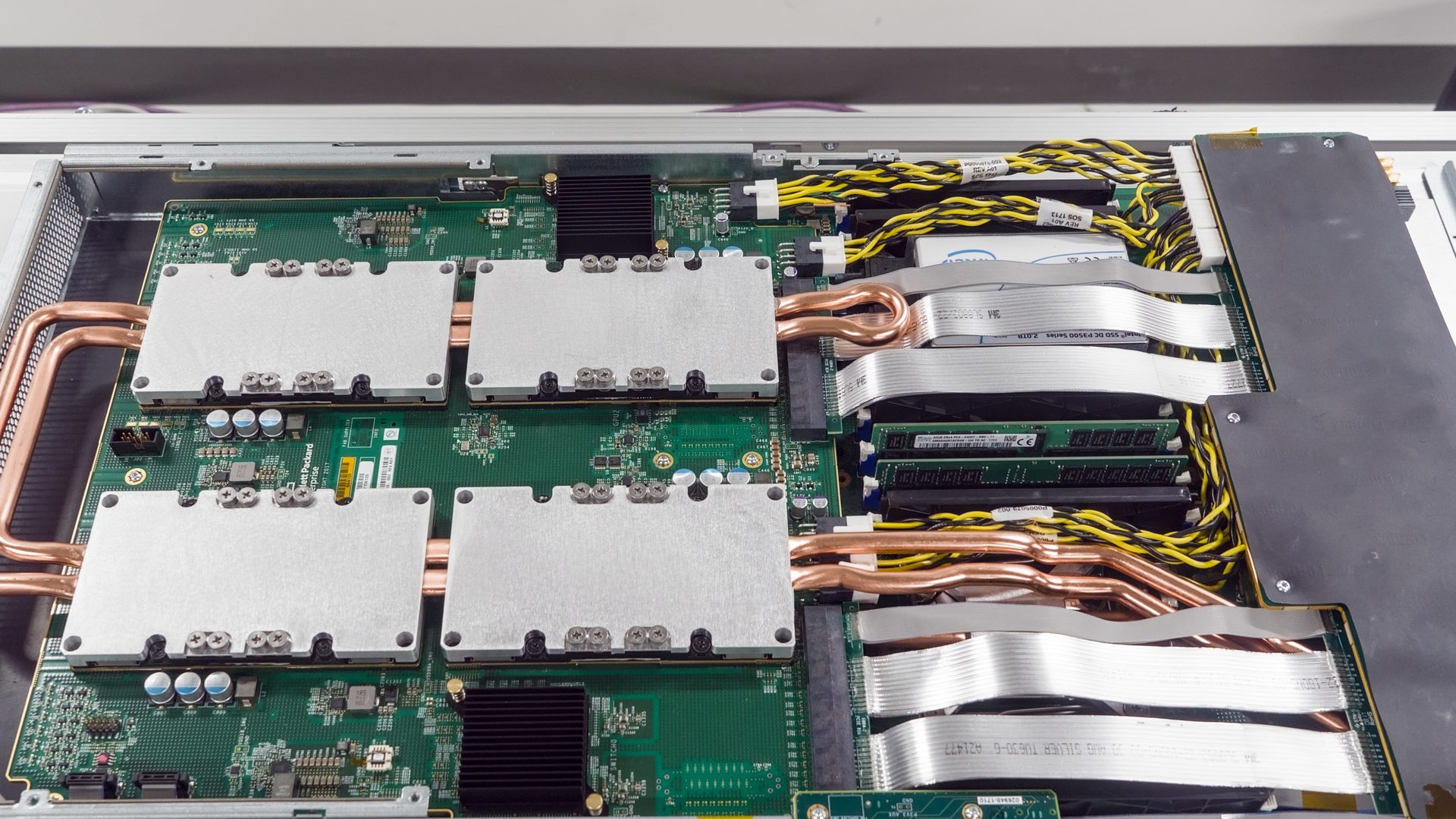
The core is eight Tesla V100-SXM2 cards with 32GB of memory each. Instead of normal PCIe slots, they sit on two four-card boards, and the cards on each board talk over Nvidia’s NVLink.
Here is the parts list as Tom’s Hardware and the builder describe it.
| Part | What he used | Note |
|---|---|---|
| GPUs | 8x Tesla V100-SXM2-32GB | 2018-era, 256GB total |
| GPU boards | 2x four-card SXM2 NVLink boards | About $2,400 each when bought |
| Links | 4 PEX switch cards, SlimSAS cables | Boards meet over PCIe |
| CPU | AMD Threadripper Pro 3945WX | 12 cores, Gigabyte board |
| RAM | 8x 32GB DDR4 RDIMM | Holds the Engram tables |
| Power | Two PSUs, 2,800 W total | Separate office circuits |
The used market has moved since then. According to Tom’s Hardware, the builder paid roughly $400 per card, while V100 SXM2 32GB cards were listed on eBay for about $900 when the article ran. Prices checked on November 9, 2026, by Tom’s Hardware.
How Fast the Private AI Server Runs DeepSeek
The server runs DeepSeek V4.1 Flash, a 551.9 billion parameter mixture of experts model. Squeezed mostly to 2 bits, its weights still total 248.8GB.
Moreover, every expert sits in GPU memory, while about 110GB of lookup tables stay in system RAM. These are the builder’s own measurements from November 5, published on his GitHub page.
| Prompt length | First token | Code / legal (tokens/s) |
|---|---|---|
| 1K tokens | 1.2 s | 215 / 118 |
| 32K tokens | 17.2 s | 200 / 117 |
| 128K tokens | 59.2 s | 183 / 111 |
| 256K tokens | 118.7 s | 160 / 103 |
Code runs fastest because a small built-in draft model guesses five tokens ahead, and code is easy to guess. Legal writing, the real job here, lands at about 103 to 118 tokens per second. By comparison, the same model managed only 36 to 38 tokens per second on four cards a few days earlier.
Private AI for Lawyers: What the Server Does All Day
The machine handles first-pass work on case files. It reads a folder of records, pulls out facts, dates and numbers, then summarizes them and drafts routine material.
Importantly, a human still signs off. “Nothing goes out the door without a real review,” the builder wrote.
According to Tom’s Hardware, about 50% to 60% of his existing LLM workflows now run on this box instead of frontier models. He also runs a second DeepSeek server on two Nvidia DGX Spark units, and the two systems hand work to each other. The setup saves money compared with API pricing, he says, although it is not really faster.

The Catch: Power, Heat and an Old Driver
However, the build did not work on the first try. The host reset itself twice with a fatal PCIe error while the cards drew 192 to 232 W each, above a 180 W limit.
He also found a burn mark on one board’s power connector. “Check your connectors, people,” he warned. Now each card is capped at 150 W, half its 300 W rating. Memory errors disappeared once he slowed the RAM to DDR4-2666.
There is a longer-term risk too. Nvidia’s R580 driver branch is the last to support these Volta cards. In addition, the server handles one request at a time for now, and a version that serves two or three at once is still in testing.
What the Lawyer’s Private AI Server Means for You
You do not need eight data center GPUs to keep sensitive files local. Above all, the story shows that private AI is now a hardware budget question, not a research project.
Before you upload client, patient or company files to any chatbot, check where they are processed. Then try a small local model on hardware you already own. Our step-by-step guide on how to run an LLM locally starts on a $300 mini PC.
What our trend tracker saw
We track rising AI searches four times a day. On the morning of November 10, 2026, “lawyer builds private ai server” was marked Breakout over 24 hours and up 1,150% over seven days. In Google Trends, it was also the only rising search worldwide for “private ai server” that week. Ahrefs puts “private ai server” at over 1,000 monthly US searches, so the interest goes beyond one viral post.
How we reported this
On November 10, 2026 we read the Tom’s Hardware report from November 9, including the comments where the builder identified himself, and the builder’s own GitHub page with his November 5 measurements. All speed figures are his, not independent tests. We wrote the draft with AI assistance, checked every number against those two sources, and Miloš Novaković edited it. How we use AI.

Want a private AI server without the homelab wiring? The Nvidia DGX Spark packs 128GB of unified memory into a desktop box, and the lawyer runs two of them as his second server.
Want More on Local AI Hardware?
If you want a ready-made machine instead of a homelab project, compare our picks for the best desktop for AI, from quiet mini PCs to RTX 5090 towers.
Frequently Asked Questions
Who is the lawyer who built a private AI server?
Nick Mermiges, a full-time civil litigation attorney who also does LLM consulting. He shared the build on Reddit’s r/homelab and confirmed his identity in the Tom’s Hardware comments.
What is a private AI server?
It is a computer you own that runs an AI model locally. Because prompts and files never leave it, firms with confidential data can use AI without sending anything to a cloud provider.
How much did the lawyer's private AI server cost?
Each four-GPU board cost about $2,400 when he bought it, or roughly $400 per card. By November 2026, however, used V100 cards were listed near $900 each.
How fast is the lawyer's private AI server?
On his November 5 tests, it wrote code at up to 215 tokens per second and legal text at up to 118. A 128K-token prompt took about 59 seconds to start.
Can a law firm rent a private AI server instead?
Yes, many hosts rent dedicated GPU servers by the hour or month. Renting means trusting that host, though, so check where the hardware sits, who can access it and what gets logged.
Is a private AI server worth it for a business?
It can be, if you process sensitive files every day. In this case, about half of the lawyer’s AI work moved off paid APIs, though he admits the system is not faster.
Sources
Tom’s Hardware (November 9, 2026), Nick Mermiges, Volta sPLIt build notes on GitHub (measured November 5, 2026), Original r/homelab post. *Photos: TSUBAME 3.0 computing node (four SXM2 Tesla GPUs, used as an illustration, not the lawyer’s server) by Kestrel, CC BY-SA 4.0, cropped and resized; Nvidia DGX Spark by Daniel Lu, CC BY-SA 4.0, cropped and resized.*