

Disclosure: this article contains affiliate links. If you buy through them, we may earn a commission at no extra cost to you. It never decides our picks. Affiliate Disclosure · How we use AI
A voice that answers before you finish breathing changes the whole call, and this Cartesia AI review asks what that speed is really worth.
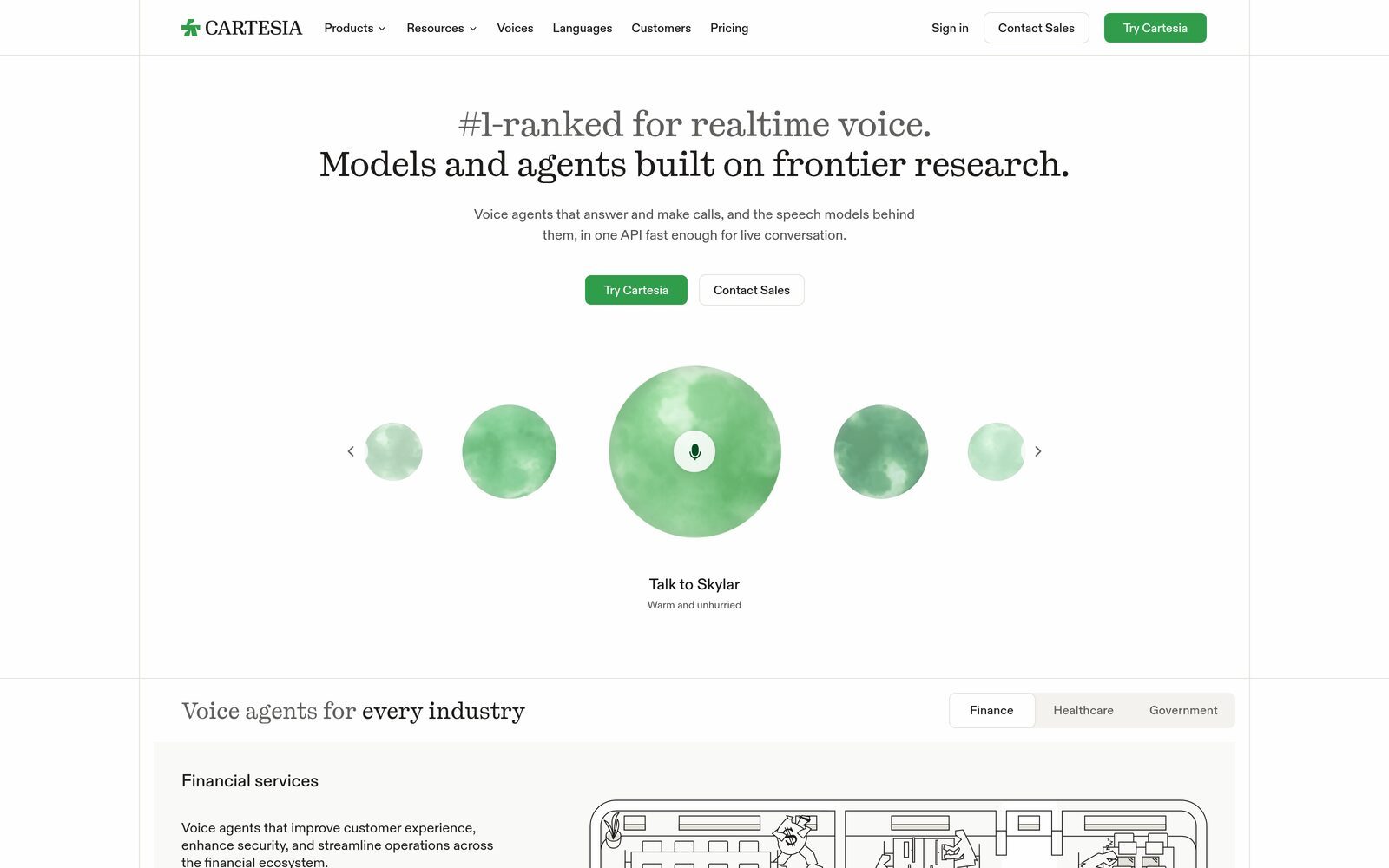
Most people meet AI voices through a phone menu that pauses too long. Cartesia AI was built to remove that pause. This Cartesia AI review looks at the Sonic voice model, the agent platform, the real prices and the trade-offs.
Searches for the brand jumped again this week in the United States. Some people type Cartesia TTS, others Cartesia Sonic or Cartesia voice AI. However, all of them point to the same San Francisco company and the same developer platform.
So the checks behind this Cartesia AI review followed three questions. First, how fast and natural is the voice? Second, what does the free plan cover? Finally, who should pick it over ElevenLabs?
What Is Cartesia AI?
So, what is Cartesia AI? It is a voice AI company that builds speech models for live conversation. Its main product, Sonic, turns text into speech. Ink does the reverse and transcribes speech into text.
The founders came out of the Stanford AI Lab in 2023. They include CEO Karan Goel and Albert Gu, a researcher known for state space models. That architecture differs from the transformers behind most chatbots, and the company says it keeps latency low.
In addition, Cartesia sells Managed Agents. These are voice agents that answer and make phone calls for a business. As a result, one account can cover the voice, the ears and the agent itself.
Who Is Cartesia AI For?
Cartesia is a builder’s tool first. Developers and startups that ship voice agents get the most from it, because speed decides whether a phone call feels human.
For example, support teams use it for order updates and appointment calls. Meanwhile, platforms such as Vapi and Retell plug Sonic in as a voice provider, so many users touch it without knowing.
However, it is a weaker fit for YouTubers who want a polished studio for narration. There is no long-form audiobook editor or dubbing suite here. Those creators will feel more at home elsewhere.
How Does Cartesia AI Work?
Four parts of the platform do most of the work. Here is what each one does and how it behaves in use.
Sonic Text to Speech: Where This Cartesia AI Review Began

First of all, Sonic is the reason most people search for Cartesia TTS. The current model on the site is Sonic-3.6. The company claims first audio in under 90 milliseconds and 44 languages from one model.
Moreover, the voices can laugh on cue. You add a [laughter] tag straight into the transcript, and the model also reads emotional subtext on its own. Cartesia says Sonic ranks first on the Artificial Analysis Speech Arena, though that badge comes from its own page.
Cartesia Voice Cloning
Instant voice cloning needs about 10 seconds of audio. It starts on the $5 Pro plan, together with the commercial use license.
Pro voice cloning, which gives a closer match, starts on Startup at $49. Training a professional clone is free, and generated speech then costs one credit per character. Still, only clone a voice you own or have permission to use.
Ink Speech to Text and Managed Agents
To begin with, Ink is the streaming transcription model, now listed as Ink-2. Paired with Sonic, it lets an agent hear and answer in one loop.
After that, Managed Agents add the phone layer. Every plan includes at least one Cartesia phone number, and agent calls cost $0.06 a minute. Phone numbers add $0.014 a minute on top.
Pronunciation Control and Deployment
For instance, custom pronunciation dictionaries tell Sonic how to say brand names and technical terms. That small feature fixes one of the most common voice agent errors.
Beyond the cloud API, Cartesia lists on-premise and on-device options. Regional endpoints also keep processing in region, which helps teams in finance, healthcare and government.
Cartesia AI Review in Practice: How Good Is It?

In daily use, speed is the headline. Third-party tests put real-world latency at roughly 166 to 190 milliseconds once network time is added. That is slower than the 90 ms lab figure, yet still quick enough for a natural phone call.
Overall, the voices sound calm and clear, especially in American English. Also, numbers, order codes and times come out correctly, which is where many cheaper voices stumble.
On the other hand, Cartesia expects you to write code. The playground is good for testing a voice, but real work happens through the API. For this Cartesia AI review, that was the biggest dividing line between happy and frustrated users.
Meanwhile, the credit meter is simple. One credit equals one character, and a minute of speech uses about 750 to 800 credits. As a result, the free 20K credits cover roughly 27 minutes of audio.
Cartesia AI Pricing Review: Is Cartesia AI Free?
Cartesia pricing has four public tiers plus Enterprise. Every price in this Cartesia AI review comes from the official pricing page, checked on October 22, 2026 with monthly billing.
| Plan | Price |
|---|---|
| Free | $0, 20K credits a month, $1 prepaid agents |
| Pro | $5 a month, 100K credits |
| Startup | $49 a month, 1.25M credits |
| Scale | $299 a month, 8M credits |
| Enterprise | Custom |
Is Cartesia AI free? Yes, the Free plan costs nothing and includes both text to speech and speech to text. However, it lists no commercial license and no voice cloning.
Therefore, Pro at $5 is the first plan you can build a product on. It adds the commercial license, instant cloning and about 133 minutes of speech. Startup then adds Pro voice cloning, organizations and five phone numbers.
Cartesia TTS Pricing for Larger Teams
Next, Scale adds priority support and high concurrency limits, with 15 parallel speech streams. Finally, Enterprise adds SSO, DPAs and BAAs for compliance, and a shared Slack channel.
Two details deserve attention. First, overages are optional and priced per million credits: $65 on Pro, $45 on Startup and $38 on Scale. Second, unused credits roll over, capped at twice the monthly plan amount.
Cartesia vs ElevenLabs: What This Review Compared
Cartesia vs ElevenLabs is the comparison most buyers make, and the answer depends on what you ship.
ElevenLabs is the broader creative studio. It covers narration, dubbing, music and a large voice library, and our ElevenLabs review walks through its credits. Cartesia, by contrast, is narrower and built around live speed.
So which should you pick? Choose ElevenLabs when the audio file is the product. Instead, choose Cartesia when a live agent has to answer a caller without a pause. Entry pricing also favors Cartesia, at $5 against the $6 ElevenLabs Starter plan.
Is Cartesia AI Legit? What This Review Checked
Yes, Cartesia AI is a legitimate and well-funded company. In March 2025 it raised a $64 million Series A led by Kleiner Perkins, as Fortune reported. At that point Sonic already served more than 10,000 customers.
Similarly, named customers on its site include ServiceNow, Quora and Retell. In addition, voice agent platforms list Cartesia as a built-in provider, so yes, Vapi integrates with Cartesia.
Two caveats stand. First, the 90 ms and number one ranking claims come from the company. Second, the free plan is for testing, not for a commercial product.
Cartesia AI Review: Alternatives Worth Comparing
Cartesia AI vs ElevenLabs

ElevenLabs is the best known AI voice platform, with more than 90 languages, dubbing and music. It is the stronger choice for creators who publish audio.
Pick it when you need a studio, not just an API. Its agents are fast too, though Cartesia still leads on raw response time.
Cartesia AI vs Murf AI

Murf AI focuses on business voiceovers for training videos and presentations. In fact, its studio syncs voice to slides without any code.
It is simpler for office teams. However, it is not designed for live phone agents.
Cartesia AI vs Fliki

Fliki turns a script into a finished video with stock footage and an AI voiceover. Overall, it suits marketers who want picture and sound in one tool.
In contrast, Cartesia gives you a raw voice stream and leaves the product to you.
Cartesia AI Review Scorecard: Where It Excels and Where It Falls Short
Pros
- Very low latency, with first audio claimed under 90 ms and about 166 to 190 ms measured in real calls
- One speech model covers 44 languages
- Instant voice cloning from 10 seconds of audio, starting on the $5 Pro plan
- Inline laughter tags and natural reading of numbers and order codes
- Text to speech, speech to text and phone agents under one account
- Free plan with 20K credits a month and no card needed to test
Cons
- Built for developers, so non-coders get little beyond the playground
- No long-form studio, dubbing editor or music tools like ElevenLabs offers
- No commercial license and no voice cloning on the free plan
- Speed and ranking claims come mainly from the company itself
- Agent minutes and phone numbers are billed on top of credits
Cartesia AI Review Verdict: Is It Worth It?
Is Cartesia worth it? For anyone building a live voice agent, yes. Few voice models answer this fast, and the $5 Pro plan makes a serious test cheap.
For example, a startup can prototype a support line on Pro and move to Startup once real calls arrive. On the other hand, a podcaster or audiobook author should look at ElevenLabs first.
The short answer from this Cartesia AI review: buy it for speed, not for a studio. In a phone call, the pause is what callers remember. Cartesia is built to make that pause disappear.
Want More After This Cartesia AI Review?
A fast voice is only one part of an agent. Our guide to the top agentic AI frameworks covers the tools that give that voice a brain.
If you would rather make audio than run a call center, the best AI music generators collection compares the tools that write full tracks. For video with an AI presenter, see our HeyGen review.
Frequently Asked Questions
What is Cartesia AI?
Cartesia AI is a San Francisco voice AI company founded at the Stanford AI Lab in 2023. It builds the Sonic text to speech model, the Ink speech to text model and managed voice agents.
Is Cartesia AI free?
Yes, Cartesia AI has a Free plan with 20K credits a month. That covers about 27 minutes of speech. However, it includes no commercial license and no voice cloning.
How much does Cartesia cost?
Cartesia pricing starts at $5 a month for Pro and $49 for Startup. Scale costs $299 a month. Meanwhile, Enterprise pricing is custom and adds SSO and compliance agreements.
What is Cartesia Sonic?
Sonic is the Cartesia text to speech model, currently Sonic-3.6. The company claims first audio in under 90 milliseconds and 44 languages. Also, it can laugh on cue through inline tags.
Does Vapi integrate with Cartesia?
Yes, Vapi lists Cartesia as a built-in voice provider. As a result, you can pick Sonic voices inside a Vapi agent without building your own speech pipeline.
Is Cartesia better than ElevenLabs?
Cartesia is usually faster for live voice agents. ElevenLabs, by contrast, offers more creative tools such as dubbing, music and long-form narration. Therefore the better pick depends on your project.
Who invested in Cartesia?
Kleiner Perkins led the Cartesia Series A of $64 million in March 2025. In addition, the founding team includes Karan Goel, Albert Gu, Arjun Desai, Brandon Yang and Stanford professor Chris Re.