A fusion physics guess from 1967 just met a team of AI agents. This is the Google AI plasma confinement research everyone is searching for.
Google AI plasma confinement research is trending after reports that Gemini helped find new counterexamples to Grad’s conjecture, a 59-year-old idea about how magnetic fields hold hot fusion plasma. The story is real, but it is also more interesting than the headlines. Two rival AI models and one human team all played a part.
What Is Grad’s Conjecture?
In 1967, Harold Grad of New York University made a bold guess about plasma equilibria. A smooth 3D equilibrium with changing pressure, he argued, generally needs some symmetry in its magnetic field.
In practice, that means a doughnut shape that looks the same as you go around it, like a tokamak. However, for decades nobody could write down a clean solution that broke this rule.
So the conjecture stayed open. In fact, it was never proven, and it was never clearly refuted with explicit formulas either.
Stellarator Plasma Confinement and Why Symmetry Matters
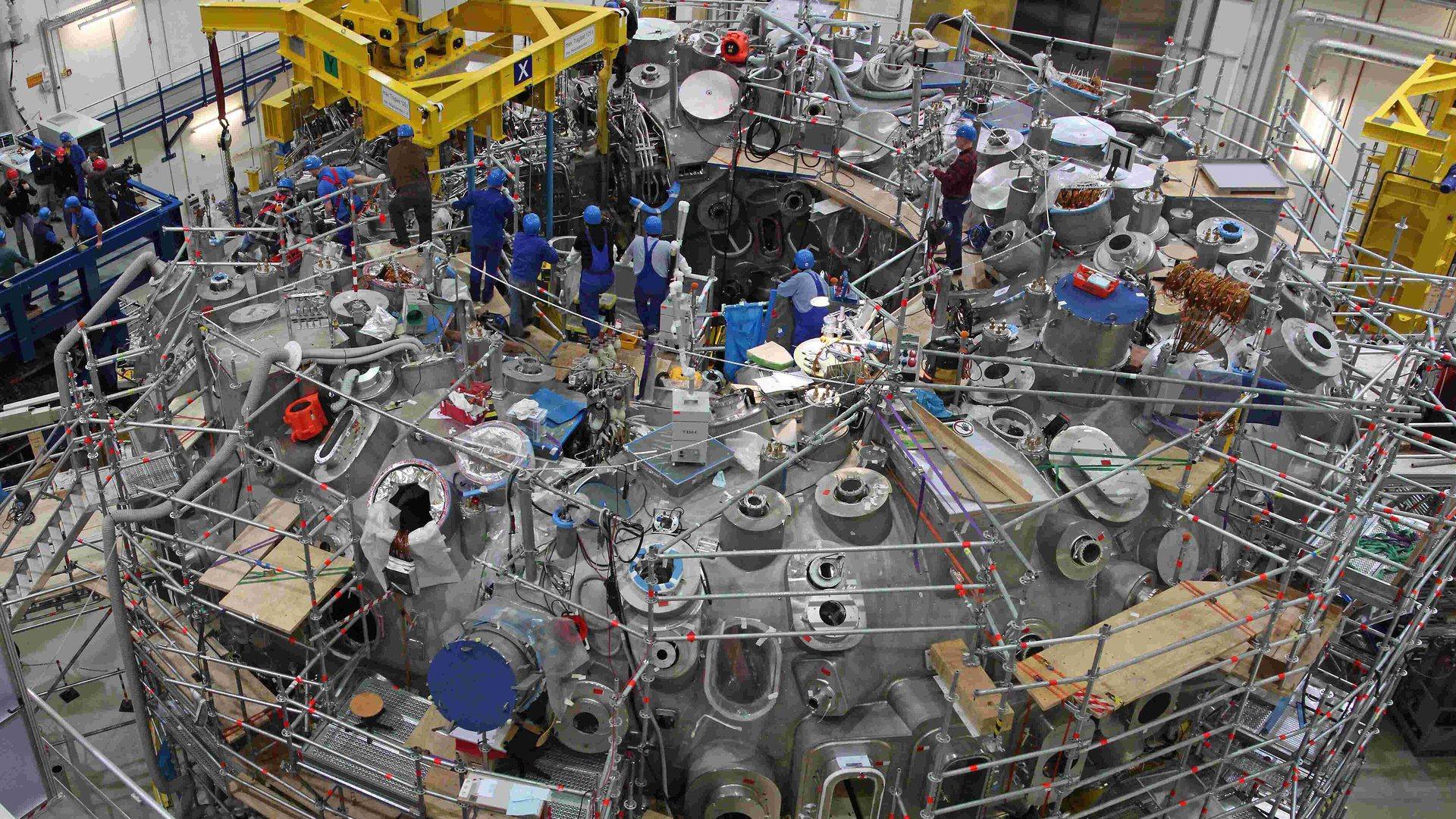
This is not just a puzzle for mathematicians. For example, stellarators confine plasma with twisted, asymmetric coils, unlike the symmetric tokamak design used by ITER.
If Grad were fully right, smooth stellarator plasma confinement would sit on shaky theoretical ground. As a result, any exact solution without that symmetry is useful to the field.
According to Startup Fortune, such solutions can also serve as benchmarks for stellarator design codes like VMEC. In other words, they give engineers a known answer to test their software against.
Google AI Plasma Confinement Research: The DeepMind Fusion Paper
On October 5, 2026, three Google DeepMind researchers and Matt Landreman posted a new paper to arXiv. The authors are Opal Issan, Jonathan Citrin, Matt Landreman and Brendan Tracey.
Specifically, their work takes two known families of solutions and adds a parameter that breaks stellarator symmetry. When that parameter is zero, the original solutions come back.
According to MACCUS, the team credits Gemini 4, run as a small team of agents. Startup Fortune reports it was Gemini 4 Argon, the model Google launched on September 30, 2026.

GPT-6 Astra Pro Found the First Explicit Solutions
Here is the twist most headlines skip. The DeepMind paper builds on solutions that Landreman, of the University of Maryland, posted on September 22, 2026.
Surprisingly, those solutions came from a rival model. The acknowledgments of Landreman’s arXiv paper say they were discovered using OpenAI’s GPT-6 Astra Pro, as reported by MACCUS.
Landreman then checked every equation by hand. In addition, the paper describes two families of exact solutions written with elementary functions, with smooth fields and nested flux surfaces.
Three Grad Counterexample Papers in Two Weeks
The timeline moved fast. Here is who posted what, based on the three arXiv pages.
| Team | What they posted | Date |
|---|---|---|
| Harold Grad (NYU) | The original conjecture about symmetry | 1967 |
| Gomez-Serrano, Liehr, Taylor | Proof that counterexamples exist, certified in Lean 4 | Sept 21, 2026 |
| Matt Landreman | Explicit solutions found with GPT-6 Astra Pro | Sept 22, 2026 |
| Landreman, revised | Second version of the same paper | Sept 28, 2026 |
| Issan, Citrin, Landreman, Tracey | Solutions without stellarator symmetry, credited to Gemini 4 | Oct 5, 2026 |
Notably, the first paper is a 147-page human proof. Its equilibria have exactly cyclic symmetry, so they lack the mirror, axial and helical symmetries Grad expected.
How the Researchers Kept the AI Honest
None of these teams simply trusted a chatbot. In the DeepMind fusion paper, the human authors chose the problem and steered the agents, according to MACCUS.
They also ran adversarial review and re-derived every result themselves. Meanwhile, the Gomez-Serrano team went further and certified its proof in the Lean 4 proof assistant.
However, there is one caveat. Startup Fortune notes that Google has not published a detailed account of how Argon reasoned. Its description comes from a DeepMind thread on X.
What Google AI Plasma Confinement Research Means for Fusion Energy
It is tempting to read this as AI cracking fusion. It is not. These results are about whether certain equilibria exist, not about building a working reactor.
Similarly, Startup Fortune makes the same point. Confinement is only one layer of the problem, next to materials, tritium breeding and economics.
Still, the pattern matters for AI fusion energy research. AI agents are moving from pure math into fields where answers can be checked. Landreman’s own paper also leaves a bigger question open: whether exact quasisymmetric solutions exist at all.
Want More on Google AI Plasma Confinement Research?
If you want to dig into papers like these yourself, start with our guide to the best AI research tools for finding, reading and citing studies. Then see how a similar race played out when OpenAI took on the Navier-Stokes problem.
Frequently Asked Questions
What is Grad's conjecture?
Harold Grad proposed in 1967 that smooth 3D plasma equilibria with varying pressure generally need a symmetry. It matters for stellarators, which use twisted, asymmetric magnetic coils.
Did Google AI disprove Grad's conjecture?
Not alone. A human team proved counterexamples exist, and GPT-6 Astra Pro helped Landreman find explicit ones. Later, Gemini 4 helped DeepMind researchers extend them without stellarator symmetry.
Who wrote the DeepMind fusion paper?
Opal Issan, Jonathan Citrin, Matt Landreman and Brendan Tracey posted it to arXiv on October 5, 2026. Three of the four authors are Google DeepMind researchers.
Which Gemini model was used?
MACCUS says the team credits Gemini 4 running as a small team of agents. In contrast, Startup Fortune names Gemini 4 Argon, which Google launched on September 30, 2026.
Does this bring fusion power closer?
Not directly. These are exact solutions that help test stellarator design codes. Practical fusion still depends on materials, tritium breeding and economics.
How were the AI results checked?
Landreman verified every equation by hand. Meanwhile, the DeepMind authors re-derived each result, and the Gomez-Serrano team certified its proof in Lean 4.
Sources
Startup Fortune (October 17, 2026), MACCUS, arXiv 2609.24739, Gomez-Serrano, Liehr, Taylor, arXiv 2609.26742, Landreman, arXiv 2610.07304, Issan, Citrin, Landreman, Tracey. *Photos: Wendelstein 7-X torus hall by Max-Planck-Institut für Plasmaphysik, Tino Schulz, CC BY-SA 3.0, cropped and resized; Google DeepMind headquarters in London by Gciriani, CC BY-SA 4.0, resized and placed on a blurred background.*