Disclosure: this article contains affiliate links. If you buy through them, we may earn a commission at no extra cost to you. It never decides our picks. Affiliate Disclosure · How we use AI
RTX 5090 memory capacity. Two-thirds the price. One three-letter catch: ROCm.
What Is the AMD Radeon AI PRO R9700?
The AMD Radeon AI PRO R9700 ($1,299 official) is AMD’s loudest AI statement yet: 32GB of GDDR6 on a full RDNA 4 chip, 64 compute units, 128 AI accelerators, up to 1,531 TOPS of INT4 sparse compute, at 300W.
The pitch writes itself: the same VRAM capacity as a $1,999 RTX 5090 for $700 less, aimed squarely at developers who run large models locally and care about memory above all.
32GB for $1,299: The Value Case
For large-model inference, capacity beats speed: a model that fits runs, one that does not fits nowhere. The R9700 hosts the same quantized 70B-class models and long contexts as the 5090, making it the cheapest new ticket to that capability tier.
Phoronix’s Linux benchmarks show single- and dual-GPU setups scaling well, two R9700s deliver 64GB of pooled VRAM for nearly the price of one 5090.
AMD Radeon AI PRO R9700 Price in 2026: What It Really Sells For
The official AMD Radeon AI PRO R9700 price is still $1,299. However, few buyers pay exactly that.
Launch listings from partners ranged from $1,244 to $1,277. Since then demand has kept prices firm. For example, one price tracker put the lowest US average at about $1,320 in July 2026, and Newegg’s regular price sat at $1,329.99. Meanwhile third-party sellers have asked $1,499 or more when stock ran short.
So a fair price in late 2026 is anything up to about $1,350. Above $1,500 the value case weakens, because the gap to a used RTX 3090 pair or a new RTX 5090 shrinks.
ROCm in 2026: Honest State of Play
ROCm now covers the essentials properly: PyTorch, llama.cpp and Ollama all run on the R9700, and AMD claims up to 2x AI throughput over its previous generation. For inference-centric workflows, the experience has become genuinely fine.
Nevertheless, CUDA remains the path of least resistance. Cutting-edge tools, fine-tuning scripts and tutorials assume NVIDIA first; on AMD you occasionally arrive a few weeks late or compile something yourself. Budget that friction honestly.
Power, Drivers and Price Reality
At 300W the R9700 is dramatically easier to power and cool than a 575W 5090. An ordinary workstation takes it without drama. Pro-series drivers prioritize stability over gaming flash.
One caveat: demand has pushed street prices above the official $1,299 at times, eroding the value gap. At list price the math sings; at scalper prices, recheck against used-3090 pairs and the 5090.
Radeon AI PRO R9700 Gaming Performance and Memory Bandwidth
Many buyers ask whether this workstation card can also play games. It can. The R9700 uses the same Navi 48 chip as the Radeon RX 9070 XT, with 32GB of memory instead of 16GB.
As a result, gaming performance lands within a few percent of the RX 9070 XT. German outlet PCGH called the two largely equivalent, and one benchmark aggregator puts the gaming card about 7% ahead. However, you pay roughly twice as much for memory that games do not use.
Memory bandwidth is the other number people search for. The R9700 moves about 640 GB/s over a 256-bit bus, the same as the RX 9070 XT. That is well below the GDDR7 flagships, which is why an RTX 5090 generates tokens faster even though both cards hold 32GB.
How AMD Radeon AI PRO R9700 Compares
Which R9700 Card to Buy: ASRock Creator, XFX, Sapphire or Gigabyte
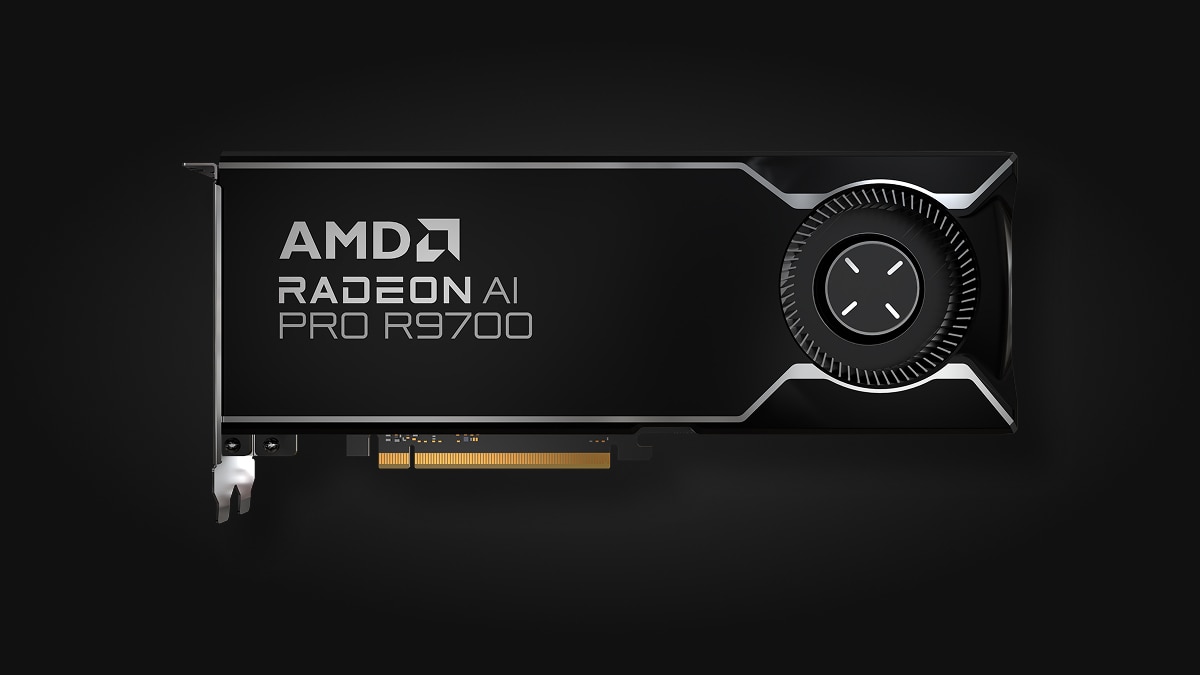
AMD does not sell the card itself, so you choose between partner versions. Most of them are two-slot blower designs, including the ASRock Creator. That shape matters for AI rigs, because blower cards push heat out of the case and can sit side by side.
Therefore, if you plan a dual-card build with 64GB of VRAM, pick a blower model. For a single card in a roomy case, buy whichever version is cheapest that week, since the chip and the 32GB of memory are identical. Our buy link opens the XFX version.
Pros and Cons
What we liked
- 32GB of VRAM for $1,299, cheapest new ticket to big models
- 300W: easy to power, cool and rack in pairs
- ROCm runs PyTorch, llama.cpp and Ollama properly now
- Dual-card 64GB setups undercut everything NVIDIA
What could be better
- CUDA ecosystem still leads in tooling and tutorials
- Lower memory bandwidth than the GDDR7 flagships
- Street prices sometimes float above the official $1,299
Who Should Buy the Radeon AI PRO R9700?
Developers comfortable outside CUDA who prioritize VRAM per dollar: large-model inference, multi-GPU memory pools, Linux workflows. If you depend on day-one support for every new tool, pay the NVIDIA tax and sleep better.
Our Verdict on the AMD Radeon AI PRO R9700
The R9700 is the strongest AI value statement AMD has ever shipped: flagship memory at upper-midrange money, with ROCm finally good enough to trust for inference work. It earns the AMD slot in our best GPU for AI guide, eyes open about the ecosystem trade.
Frequently Asked Questions
Is the AMD R9700 good for AI?
Yes, 32GB of VRAM at $1,299 makes it the cheapest new card for large-model local inference, with RDNA 4 AI accelerators rated up to 1,531 TOPS INT4 sparse.
Does Ollama work on the AMD R9700?
Yes, Ollama, llama.cpp and PyTorch all run via ROCm. Expect occasional extra setup compared with the CUDA experience.
AMD R9700 vs RTX 5090: which for local AI?
Same 32GB capacity; the 5090 adds much higher bandwidth and the frictionless CUDA ecosystem for $700 more. Value: R9700. Maximum speed and zero friction: 5090.
Can you run two R9700s together?
Yes, dual-R9700 rigs pool 64GB of VRAM for roughly $2,600, a popular Linux setup that Phoronix benchmarked scaling well.
How much power does the R9700 draw?
300W TDP, far easier to accommodate than a 575W flagship, especially in multi-GPU builds.
What is ROCm?
AMD’s open compute platform, the CUDA equivalent that lets frameworks like PyTorch run on Radeon GPUs. Coverage in 2026 is solid for mainstream AI tools, with friction on the cutting edge.
How much does the AMD Radeon AI PRO R9700 cost?
The official price is $1,299. In 2026 typical US street prices ran from about $1,320 to $1,370, and third-party sellers have asked $1,499 or more when stock was short.
Is the Radeon AI PRO R9700 good for gaming?
Yes. It uses the same chip as the Radeon RX 9070 XT and performs within a few percent of it in games. However, it costs about twice as much, so it only makes sense if you also need 32GB for AI work.
What is the memory bandwidth of the R9700?
About 640 GB/s over a 256-bit bus with 20 Gbps GDDR6. That matches the RX 9070 XT and trails GDDR7 cards such as the RTX 5090.
Is the R9700 the same as an RX 9070 XT?
Almost. Both use the Navi 48 chip at similar clock speeds. The R9700 doubles the memory to 32GB and ships with professional drivers.
Which R9700 model should you buy?
For two cards in one case, choose a two-slot blower design such as the ASRock Creator. For a single card, the cheapest partner version is fine, because the chip and memory are the same.
Want More Than This AMD Radeon AI PRO R9700 Review?
Choosing between cards? Our full best GPU for AI guide ranks every GPU here by VRAM, bandwidth and price. For the frictionless alternative, read our RTX 5090 for AI review. For everything else we have reviewed, browse all our AI hardware reviews.