
Disclosure: this article contains affiliate links. If you buy through them, we may earn a commission at no extra cost to you. It never decides our picks. Affiliate Disclosure · How we use AI
Students are finishing graded work in minutes with AI. The Office for Students AI assessment warning says universities now have to change how they test.
The Office for Students AI assessment warning landed on November 11, 2026. England’s higher education regulator said students can complete many unsupervised assessments to a high standard with AI, sometimes in minutes. As a result, it wants far more AI-free assessment.
What the Office for Students AI Assessment Warning Says
The warning comes from a joint report by the Office for Students (OfS) and the charity Advance HE. Its title is Making AI work for students: reflections on institutional practice.
Its core line is blunt. “AI poses significant risks to the validity and effectiveness of assessments,” the report says. In addition, it found that students can often complete unsupervised work well with AI without showing the knowledge or skills being tested.
According to the BBC, the research said that if students can pass an assessment this way, “the assessment should be replaced”.
Students Passing Assessments in Minutes Using AI
The most striking detail came from the people interviewed. Participants told the OfS about students who completed whole assessments in minutes with AI. Those students then got grades similar to classmates who did the work themselves.
Lecturers described the strain too. Some said they now receive many assignments that look the same, cite the same literature and share one writing style, according to The Guardian.
One unnamed academic said AI had “put academic integrity at serious risk”. Meanwhile, some students could not recall basic details of work they had submitted.
Making AI Work for Students: Inside the OfS Report
The report is not a rulebook. Instead, it gathers what staff and students said and adds case studies and prompts for institutions. Here are its main numbers and findings.
| Point | What the report and coverage say | Source |
|---|---|---|
| Published | November 11, 2026, reference OfS 2026.56 | OfS |
| Fieldwork | June to September 2026 | OfS |
| Participants | 244 staff and 91 students | BBC |
| Institutions | At least 127 universities and colleges | BBC |
| Detection | Tools do not consistently and reliably identify AI use | OfS |
| Most effective formats | Closed-book and practical exams | BBC |
| Training | Uneven for students, often optional for staff | OfS |

Is Using AI Cheating at University?
That depends on the course, and that is part of the problem. The report found that many students are unclear about where AI is allowed in graded work. Likewise, institutions usually cannot confirm whether a student followed the rules.
Detection does not fix this. The OfS says AI detection tools “do not consistently and reliably identify AI use”. Tech Times notes that Turnitin itself reported a sentence-level false positive rate of about 4%.
Use is near universal anyway. A 2026 HEPI survey of 1,054 UK undergraduates found that 94% use generative AI for assessed work. However, only 12% said they put AI-generated text directly into it.
AI-Free Assessment: What Universities Are Changing
Josh Fleming, OfS director of strategy and delivery, called AI “a generational risk to the system as it stands”. He also praised “fantastic” examples of universities using AI well, the BBC reported.
Still, his ask was clear: far greater use of AI-free assessment. The report itself says secure approaches designed to prevent AI use “will often be the most effective”.
Universities UK, which represents more than 140 institutions, says many have already moved. Their changes include more in-person exams, presentations, vivas and process-based assessment. On the other hand, it argues that different subjects need different approaches.
Could the Office for Students AI Assessment Warning Lead to Sanctions?
Possibly, but not overnight. The Guardian reports that universities without fair and dependable assessment could breach their registration conditions and face sanctions.
The relevant rule is Condition B4, which already requires valid and reliable assessment. Notably, its text does not mention generative AI, Tech Times points out.
Meanwhile, the OfS is consulting on a new quality framework. Under those proposals, weak providers could lose higher fees or face caps on student numbers. The Department for Education says it expects universities to take the issue seriously.
What the Office for Students AI Assessment Warning Means for You
If you are a student, ask each lecturer what AI use is allowed before you start. Get the answer in writing, because the report found that unclear rules are common.
Next, keep your drafts and version history. With more process-based assessment coming, showing how your work grew is stronger than any score. For example, GPTZero’s Writing Replay plays back how a Google Doc was written. Our GPTZero review explains it, along with its accuracy limits.
Finally, the National Union of Students sees an opening. Its Lewis Wilson said outdated methods should be replaced, with new ones co-designed with students.
What our trend tracker saw
We track rising AI searches four times a day. On the morning of November 12, 2026, “office for students ai assessment warning” was up 350% over 24 hours. In Google Trends, worldwide, it was a Breakout query and the top related search for both “ai assessment” and “office for students” that week. In other words, people were not searching for a tool. They wanted to know what the regulator actually said.
How we reported this
On November 12, 2026 we read the OfS publication page for the report (OfS 2026.56), the BBC report republished on Yahoo News, The Guardian report republished on AOL, and the Tech Times analysis. Every quote comes from those pages. We wrote the draft with AI assistance, checked each figure against the sources, and Miloš Novaković edited it. How we use AI.

Process evidence beats a detector score. GPTZero’s free plan checks 10,000 words a month, and Writing Replay shows how a Google Doc was actually written.
Want More on AI in Higher Education?
If you teach, compare tools that help with lesson planning, feedback and AI checks in our guide to the best AI tools for teachers.
Frequently Asked Questions
What is the Office for Students AI assessment warning?
It is the regulator’s finding, published on November 11, 2026, that many unsupervised university assessments can be completed with AI. As a result, it is calling for far greater use of AI-free assessment.
What is the Making AI work for students report?
This is a joint OfS and Advance HE report, reference OfS 2026.56. It draws on over 300 students and staff from more than 120 institutions, interviewed between June and September 2026.
Can universities detect AI in assignments?
Not reliably. The OfS says AI detection tools do not consistently identify AI use. Therefore a detector flag should start a conversation, not settle a misconduct case.
What is AI-free assessment?
AI-free assessment means testing in conditions where AI cannot help, such as closed-book exams, practical tasks, presentations and vivas. The report found closed-book and practical exams most effective.
Will universities be fined over AI assessment?
Not yet. Universities could breach Condition B4 if assessment is unreliable. However, new quality framework penalties, such as fee or student number limits, are still in consultation.
Is using AI cheating at university?
Only when it breaks your course rules. Many students are unsure where the line sits, so ask each lecturer and keep drafts that show how your work developed.
Sources
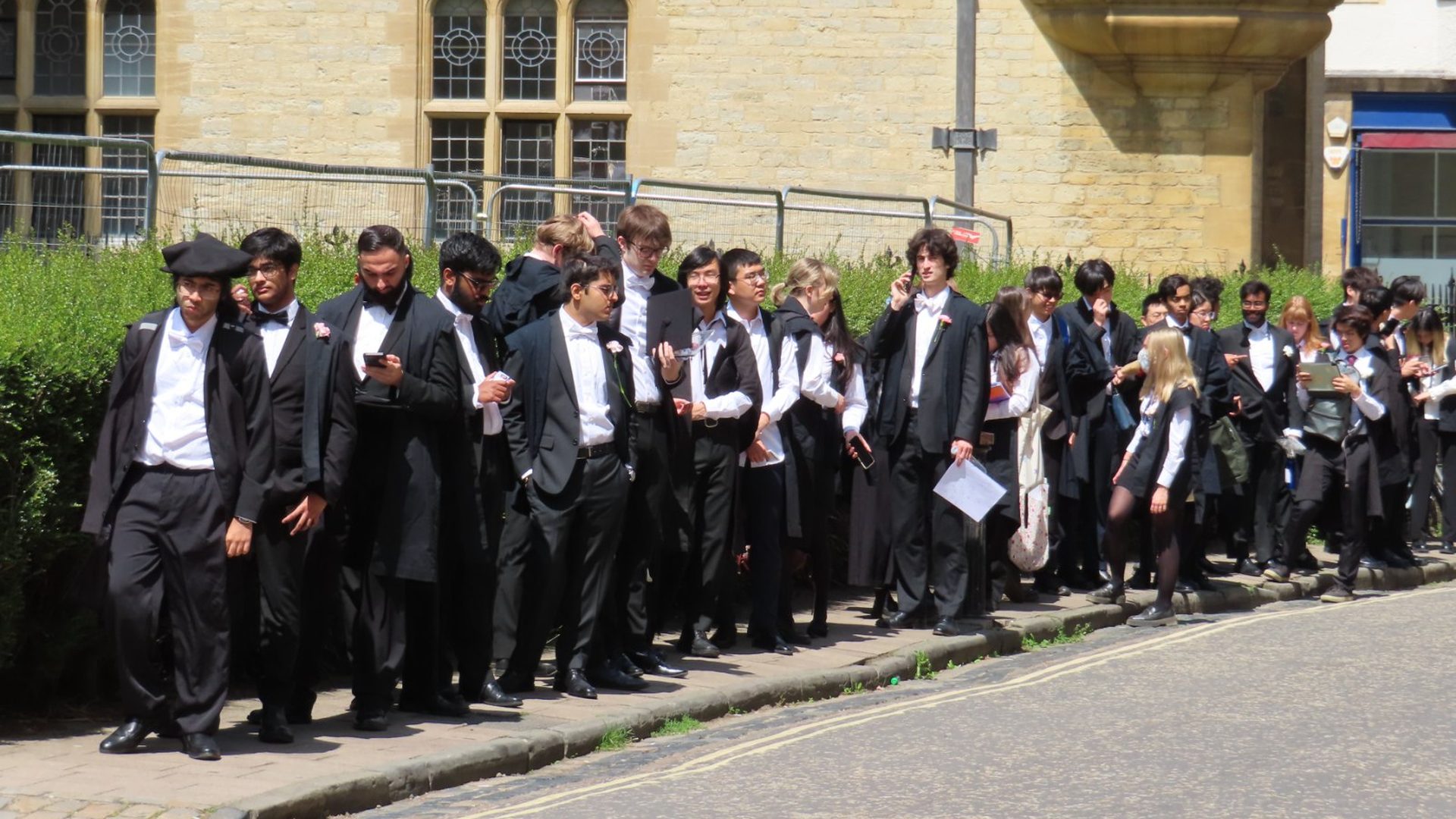
Office for Students, Making AI work for students (OfS 2026.56, November 11, 2026), BBC via Yahoo News (November 11, 2026), The Guardian via AOL (November 11, 2026), Tech Times (November 12, 2026).*Photos: University of Oxford Students about to sit exams by Philip Halling, CC BY-SA 2.0, cropped and resized; Brunel University lecture theatre by Suntooooth, CC BY-SA 4.0, cropped and resized.*